
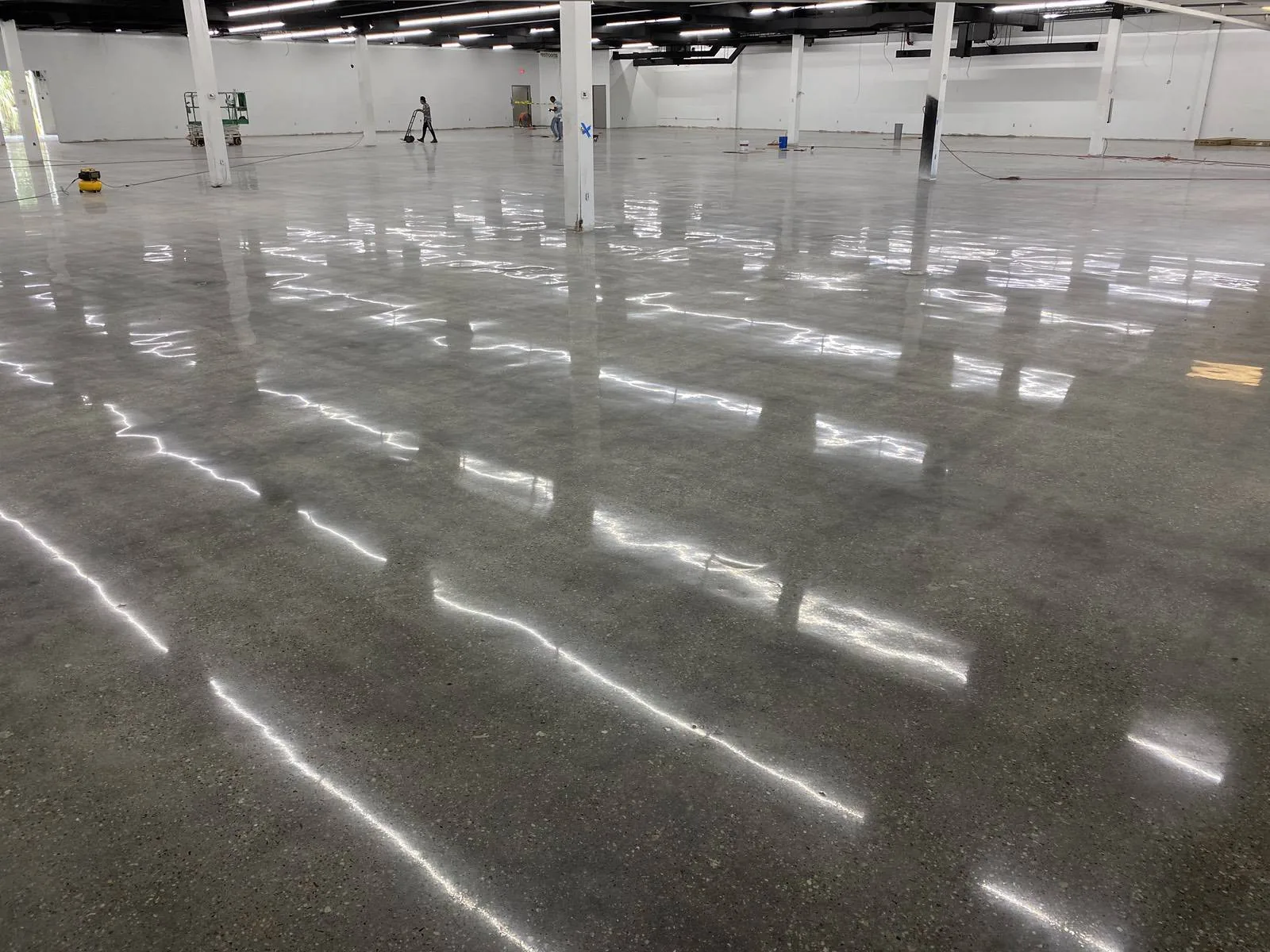
Concrete densifier that hardens the slab surface
A densifier soaks into the slab and reacts with the lime in the paste, hardening the top of the concrete so it wears slower and sheds less. We put it down on its own or inside a polish.
22 years in businessPolished5.0 on Google from 36 reviews
What it is
Densifying is chemistry, and it is the quiet step inside nearly every polished floor we put down. A lithium or sodium silicate goes on wet, soaks into the pores and reacts with the calcium hydroxide left in cured concrete. What it leaves behind is more hard binder in the top of the slab. The surface tightens up, takes forklift wheels and pallet jacks with less wear and lets go of less powder. We lean on lithium because it tends to go on cleaner and leave less white residue to scrub off.
Bought on its own, it goes to warehouses, distribution centers, shops and plants that want a harder, cleaner slab and have no use for shine. On a newer slab in decent shape we clean it, scrub the densifier in and burnish, and the building goes back to work quickly. Shops and service bays like the result because tire marks and spills soak in slower on a densified surface. On a slab with sealer or curing compound on it, we grind first, because a densifier cannot get through a film.
Now the twins. Concrete Polishing is the full run of grinding and refining to a sheen, and densifier is one step inside it. Concrete Dustproofing is the fix for a slab that is already shedding: grind off the weak laitance first, then densify and guard. Densifying on its own is for a slab that mainly needs its surface hardened. Densifier does not make a floor oil-proof or chemical-proof; that is coating work. If your floor throws dust on every rack, you want dustproofing. If you want it to shine, you want polishing.
Part of our polished work. See all of it.

Start with the concrete.
What goes down, from the surface you walk on to the slab under it.
We will not spray densifier over curing compound and call the floor done; it sits on top, dries white and does nothing for the slab.
Burnished surface
A high-speed burnish closes the top and leaves a hard, low-sheen floor you can roll on.
Scrub and pickup
The excess is worked in with a scrubber and picked up before it dries white on the surface.
Densifier soak
Lithium silicate is spread and kept wet long enough to get down into the paste.
Clean or grind
Scrubbing opens a clean slab, and a grind takes off any film the densifier cannot soak through.
Slab as found
Cured concrete, a little soft at the top, often carrying curing compound, sealer or a gray film of dust.
Where it belongs
Warehouses and distribution
Rack aisles and dock floors get a harder surface that holds up to forklift wheels and stops dusting the inventory.
Shops and service bays
A densified slab sweeps cleaner, and tire marks come up with a scrub more often than they would off raw concrete.
Inside a polish
Every polished or honed floor we do gets densified between the grind and the refine, because the shine needs hard paste under it.
Slabs changing tenants
A bare floor going back into service can be cleaned and hardened without the cost and downtime of a coating.
How the crew runs it
Five steps, in order.
Read the slab
We check hardness, look for sealer and curing compound, and drop water on it to see whether the slab drinks or beads.
Open the surface
A clean slab gets scrubbed; a sealed or contaminated one gets ground until water soaks in evenly.
Apply and keep wet
Densifier goes down by sprayer or microfiber, and we keep it wet on the slab instead of letting it puddle and dry.
Work it, pick it up
An auto scrubber works it in, then the excess comes up before it can leave a white haze.
Burnish
A burnisher closes the surface, and the floor goes back to work.
For the GC or the facility
- On a clean slab, densifying is often a short job with foot traffic the same day; typical, and it depends on the product and the humidity.
- Densifier cannot get through curing compound, sealer or bond breaker, so tell us what went on the slab after the pour.
- We can work nights, weekends or a shutdown window so racks and docks keep moving.
- Product data and submittals on request.
Gulf South conditions
Humidity is what bites densifier. On a muggy day the slab is already holding water at the surface, the product stays wet longer, and the timing of the scrub and pickup shifts. We read the slab and the air that morning instead of following a clock, and we keep doors shut and air moving when the building lets us.
Warehouses along the river and near the ports see trucks drag in grit and rainwater all year, and slabs on grade push moisture up from underneath. A densified surface stands up to that grit better than raw paste. It also leaves the slab open, so vapor coming through has no film to lift the way it can lift a coating laid on a damp floor. After a storm or high water, a densified slab can be scrubbed, dried and put back in use with no coating to replace.
Look at the finish.
“On this particular project, they installed a Urethane Floor at the kitchen and bar and also polished the existing concrete floors throughout the building.”
David Hubbard, Google review5.0 on Google from 36 reviews
Living with it
Sweep or dust mop to keep grit from grinding into the surface, and run an auto scrubber with a neutral cleaner. Densifier is no stain guard, so oil and chemical spills still need to come up fast. Keep acid cleaners off the floor. When the traffic lanes look tired, a scrub and a burnish bring them back.
Next to this one
See finished floorsQuestions about concrete densifying
See finished jobs in the gallery, or reach the office.
What does a concrete densifier actually do?
It reacts with lime left in the concrete and forms more hard binder near the surface. The top of the slab gets denser and tougher and sheds less powder. It adds no film and barely changes the color.
Lithium, sodium or potassium: does it matter?
All three are silicates doing the same basic job. Lithium tends to go on cleaner and leave less residue, which helps on humid days, so it is what we usually reach for. The slab and the spec make the final call.
Is densifying the same as sealing?
No. A densifier works inside the concrete and leaves nothing on top, while a sealer or guard sits at the surface to slow stains. Plenty of floors get both, densifier for hardness and a guard for spills.
Will a densifier stop my floor from dusting?
On a slab that is only a little soft at the surface, often yes. On a floor that is badly dusting, the weak top layer has to come off first or the densifier just hardens powder. That job is dustproofing, and we will tell you which one you have.
Can you densify a new slab?
Yes, once it has cured enough for the reaction to work and nobody has put curing compound on it. Talk to us before the pour if you can, so the slab gets cured in a way that does not block us later.
How do we get a price on densifying?
Send the square footage, the age of the slab, what is on it and the schedule, or have Dustin come look. Warehouse jobs usually get priced after a walk so we can see the aisles and docks.
Let’s look at your floor.
Tell us the space, the square footage and what goes on the floor. We will tell you which system fits and when we can start.
General contractors: send drawings, square footage, finish schedule and the window you have. Submittals and samples on request.