
Damp Angie slabs and the primers that hold them
Our trucks run 76 miles north of Harvey to reach Angie. Once there, the first job is reading the slab: old sealers, glue, cracks and how much moisture it pushes up through the surface.
Angie, Washington Parish, Louisiana.
Getting to Angie
Housing figures from the US Census.
Census numbers put the typical home in Angie at about 1975. A house slab from this time can be post-tensioned. The steel cables inside sit under heavy tension, so nobody drills or saw-cuts one without knowing where the tendons run.
Grinding and coating the surface is safe, and deep cuts are a separate conversation.
Up in the Florida Parishes, Angie sits in Washington Parish, where pine and hardwood country mixes with fast-growing suburbs, small farm towns and horse pastures.
It is a mix: about 46% stand-alone houses, the rest townhomes, condos, mobile homes and apartments. Some owners here have their own garage, and some share a building with neighbors. We quote both, and shared floors usually start with a conversation with the HOA or the manager.
Numbers like these are why we ask what the space is used for before we talk systems.
Slabs in Angie deal with the same heavy rain and long humid summers as the south shore, and on-grade concrete still pulls moisture vapor up from below. Around Washington Parish, the floor work is mostly this: mill shops, timber yards, rural schools and older town buildings in Bogalusa and Franklinton, with slabs that usually need grinding first. The nearest towns on our list range from Varnado (typical home around 1965) to Baxterville (around 1993); Angie lands on the older side.
Gulf air on bare concrete
The Northshore and the Florida Parishes.
Angie is in Washington Parish, about 76 miles north of the shop.
Summers are long, hot and wet, and afternoon storms dump heavy rain fast. Garages, patios and pool decks take the most punishment from hot tires, direct sun, pine straw and standing water at the edges. Outdoors, a UV-stable topcoat matters, since plain epoxy yellows and chalks in the sun. Lighter colors and textured finishes keep a pool deck cooler underfoot and safer to walk on barefoot when it is wet.
For an equipment shed or farm shop in the country around Angie, a broadcast system with coarse aggregate gives traction a smooth coat never will.
If you are building in Angie, tell the builder you want the slab moisture tested before flooring, because tight schedules push coatings onto green concrete all the time.
Pick a lighter color and a textured finish for a pool deck, so bare feet do not burn or slide when the deck gets wet.
Good picks for this village
Garage Floor Coatings
Flake, solid color, metallic or polished concrete for home garages, ground first so hot tires and oil never lift it.

Concrete Polishing
Mechanical grind and polish of the existing slab, densified and guarded, for showrooms, warehouses, restaurants and offices that want a bright floor.
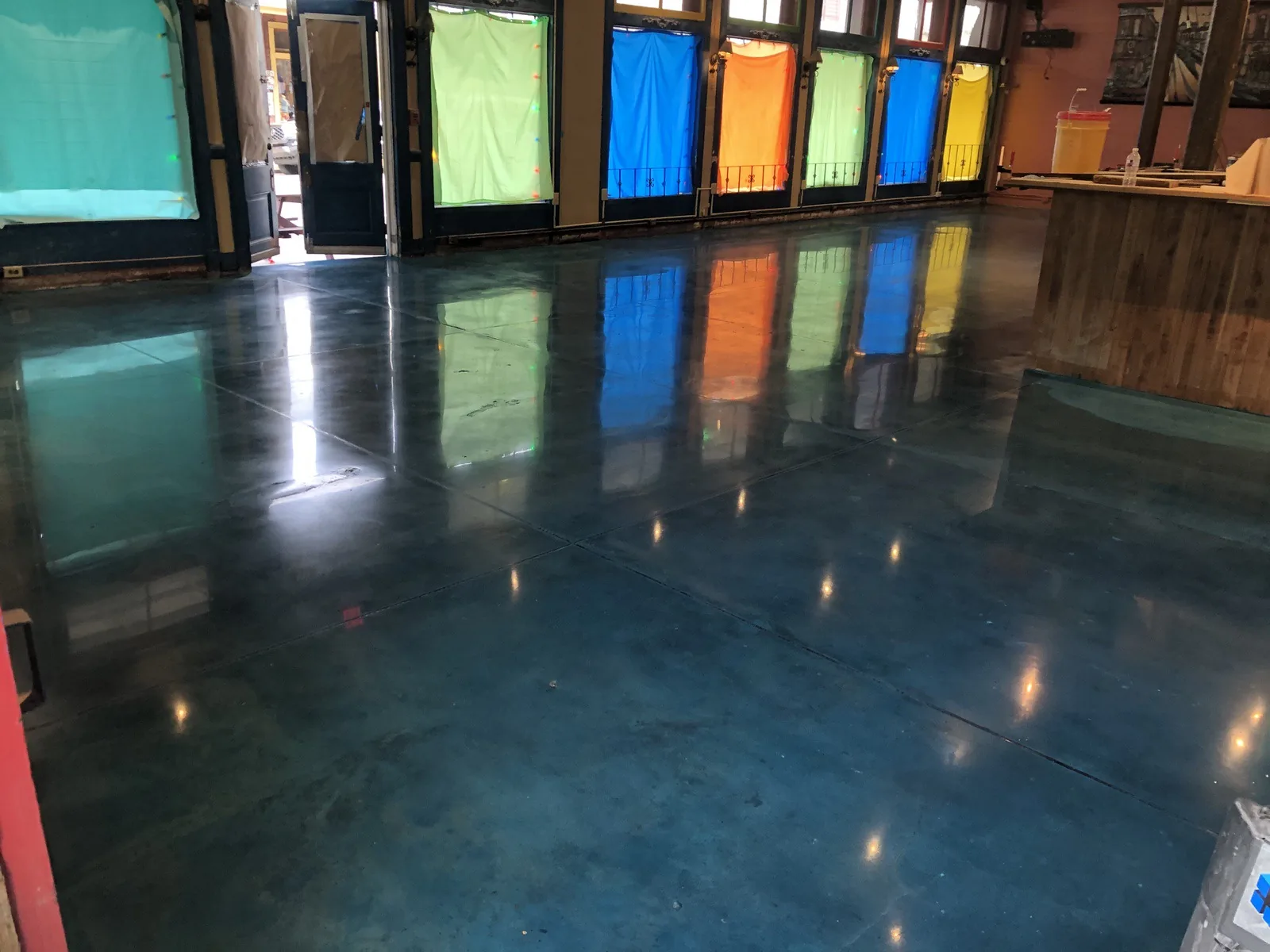
Retail Flooring
Polished, stained or metallic epoxy floors for stores, showrooms and restaurants, installed on night shifts and between tenants.
How any floor here gets built
The same order on every job, whatever the system.
Topcoat or guard, set to the traffic and the shine you want.
The color and the thickness: epoxy, urethane cement, stain or an overlay.
Soaks in and locks the system to the concrete.
Ground or shot blasted until the surface opens up and a coating can bite.
The concrete as we find it. Moisture, old sealer and cracks decide everything above it.
The next towns over
- Varnado
4.6 miles away, Washington Parish
- Bogalusa
13 miles away, Washington Parish
- Baxterville
17 miles away, Lamar County
- Rio
19 miles away, Washington Parish
More in Washington Parish, on the services page and in the gallery.
Things to know first
Or send the plans first.
Got a slab question we did not cover? Call.
(504) 231-6298Do you come out to Angie?
Yes. Angie is about 76 miles north of our base in Harvey, inside the roughly 100 miles we cover. Someone comes out, looks at the slab and gives you a price after seeing it.
What should I know about a slab from around 1975?
Concrete from then is usually sound and settled. Most of the work is removing what was glued or painted on it and filling the cracks that opened up over fifty years.
Can an older slab in a farm town be polished?
If the concrete is sound and reasonably flat, yes. Old slabs often show aggregate, patches and stains once ground, and plenty of owners like that look. Badly damaged or uneven floors may need repair or a micro-topping first.
Can you coat the slab in a brand-new house?
Yes, once the concrete has cured enough to pass a moisture test. New slabs hold a lot of water, and coating too early is how floors blister. If the schedule is tight, a moisture-tolerant primer can let the work go ahead.
What finish works best on a pool deck here?
A light-colored, textured system with a UV-stable topcoat, or a stamped overlay sealed for outdoor use. Both stay cooler and give grip when wet. Dark, glossy coatings get hot and slick, so we steer people away from them.
What floor works in an equipment shed or farm shop?
Tractors, trailers and dropped tools need a thick system with coarse texture, usually a broadcast epoxy or urethane cement over a ground slab. It cleans up with a hose and keeps its grip when the floor is wet or muddy.
Can you quote from photos or plans instead of a visit?
For commercial jobs, drawings, square footage and a schedule are often enough to price the work, with a look at the slab before we start. For homes, photos help, but we want to see the concrete in person before we commit to a system.
When can I walk on it?
Light foot traffic is typically fine within a day on most coatings, and full cure takes longer. We give you the timing for your system, because urethane cement, epoxy and polished concrete all behave differently.
Should I clean the slab before you arrive?
Sweep it if you like, but the grinder does the real cleaning. Tell us about oil spots, chemical spills or anything soaked into the concrete so we can plan for it.
Is there a best time of year for an outdoor coating?
Spring and fall usually give the most dry days and milder heat. Outdoor work happens in summer too, and we watch the radar and pick days without afternoon storms in the forecast.
Two ways to start
Tell us the space, the square footage and what goes on the floor. We will tell you which system fits and when we can start.
Send the plans
Bidding a job? Send the plans and the schedule. We price from drawings and walk the slab before we commit to a date.