
We bring the grinders to Bayou Cane
Pool decks, garages and kitchen floors around Bayou Cane all start as plain concrete, and plain concrete in the Gulf South sweats. The fix begins with grinding to an open profile and checking how much vapor comes through. It sits in Terrebonne Parish, about 45 miles southwest of Harvey.
Bayou Cane, Terrebonne Parish, Louisiana.
Bayou Cane by the numbers
Housing figures from the US Census.
The median home in Bayou Cane was built around 1983, by the Census count. A 1980s slab anywhere in the Gulf South has probably been through several named storms. Look at the bottom of the walls for water lines, salt bloom or a patched section where a wall was opened up.
Those spots get extra grinding and a moisture check before we commit to a system.
It is a mix: about 59% stand-alone houses, the rest townhomes, condos, mobile homes and apartments. Between the detached houses and the apartment buildings, this community has room for residential coatings and light commercial floors alike.
Numbers like these are why we ask what the space is used for before we talk systems.
A floor in Bayou Cane has to handle a high water table pushing moisture into on-grade slabs, on top of the humidity that comes with living among bayous and marsh. Around Terrebonne Parish, the floor work is mostly this: shipyard shops, seafood docks and raised homes, all sitting on slabs that fight moisture and salt carried in off the Gulf.
Terrebonne Parish is bayou country, and Bayou Cane shares what that means for a building: water close at hand, ground that stays damp, and storms that can roll straight in off the Gulf.
Moisture tests come first
Bayou Lafourche and Terrebonne.
Bayou Cane is in Terrebonne Parish, about 45 miles southwest of the shop.
Hurricane Ida came ashore at Port Fourchon in 2021 and ran north through these parishes, and surge has reached the lower bayou towns many times before that. Floors in flooded buildings need the old finish stripped and the contamination ground out. Cracks and joints get repaired, and the slab has to dry and pass a test before anything new goes on. Rushing a coating onto a wet, dirty slab after a storm is a reliable way to pay for the floor twice.
Run cove base and sealed joints in kitchens and seafood rooms, because water left standing where the floor meets the wall is where bacteria and failures start.
Test slab moisture before any coating goes down, since the high water table under bayou country will find any primer that was not built for it.
In a shop or yard near Bayou Cane, pick a troweled or heavy broadcast system, because welding spatter and dropped parts chew through thin coatings fast.
Matching the system to the space
Garage Floor Coatings
Flake, solid color, metallic or polished concrete for home garages, ground first so hot tires and oil never lift it.

Concrete Polishing
Mechanical grind and polish of the existing slab, densified and guarded, for showrooms, warehouses, restaurants and offices that want a bright floor.
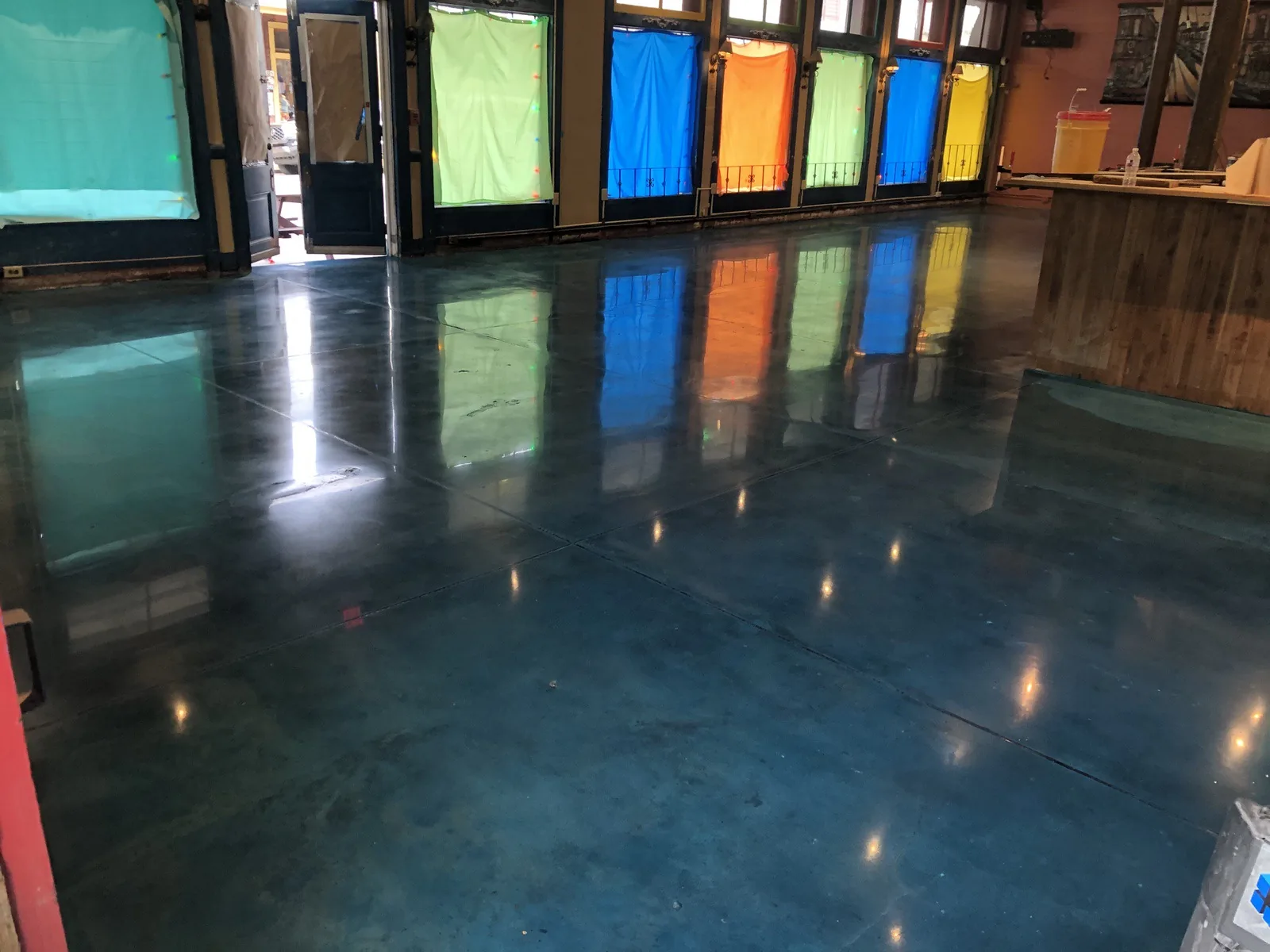
Retail Flooring
Polished, stained or metallic epoxy floors for stores, showrooms and restaurants, installed on night shifts and between tenants.
How any floor here gets built
The same order on every job, whatever the system.
The finish you actually walk on, matched to the use.
Where the system gets its build: resin, cement or a decorative overlay.
Soaks in and locks the system to the concrete.
Ground or shot blasted until the surface opens up and a coating can bite.
Whatever the slab is, it gets read first: moisture, cracks, old coatings, and how level it sits.
The next towns over
- Houma
4.1 miles away, Terrebonne Parish
- Gray
4.2 miles away, Terrebonne Parish
- Bayou Blue
5 miles away, Lafourche Parish
- Presquille
8.1 miles away, Terrebonne Parish
More in Terrebonne Parish, on the services page and in the gallery.
Before you call
Or send the plans first.
Still unsure? Dustin or Jacob will tell you straight.
(504) 231-6298Do you come out to Bayou Cane?
Yes. Bayou Cane is about 45 miles southwest of our base in Harvey, inside the roughly 100 miles we cover. Someone comes out, looks at the slab and gives you a price after seeing it.
What should I know about a slab from around 1983?
A slab this age is usually past its settling and in good shape structurally. Expect a day or so of extra prep if it had tile, and less if it had carpet.
How long before people and trucks can use a new floor?
It depends on the system and the temperature. Foot traffic often comes the next day, while vehicles and heavy loads usually wait several days for a full cure. We give you the actual times for the product we install.
What floor works in a shipyard or fabrication shop?
A thick system over a shot-blasted slab, such as troweled epoxy, urethane cement or a heavy broadcast build. These take impact, heat and oil that would wreck a thin coating. We size the thickness to what gets dropped and dragged across the floor.
Can you redo a floor after storm flooding?
Yes, once the slab has dried and been tested. We grind off the old finish and contamination, repair cracks and spalls, then install the new system. If the building is waiting on other repairs, we fit the floor into that schedule.
Which details help you put a quote together?
The size of the area, what the floor has to handle and when you need it back. For commercial work, add the specs, the shutdown window and any submittal requirements. From there we come back with a price.
Will the whole floor be out of service at once?
Not always. Larger floors can be done in sections so part of the building stays open, with the order planned around traffic. It takes longer overall, and nobody has to shut down completely.
Where do furniture, cars and equipment go?
Everything comes out of the work area, and cars stay out until the coating cures. For a plant or a kitchen, plan where the equipment sits during the job and when it comes back.
What does humidity do to a fresh coating?
Put down at the wrong moment, some coatings can turn cloudy or stay tacky at the surface. We read the dew point and slab temperature before we mix, and we hold off when the numbers are wrong.
Start with the slab
Tell us the space, the square footage and what goes on the floor. We will tell you which system fits and when we can start.
Send the plans
Bidding a job? Send the plans and the schedule. We price from drawings and walk the slab before we commit to a date.