
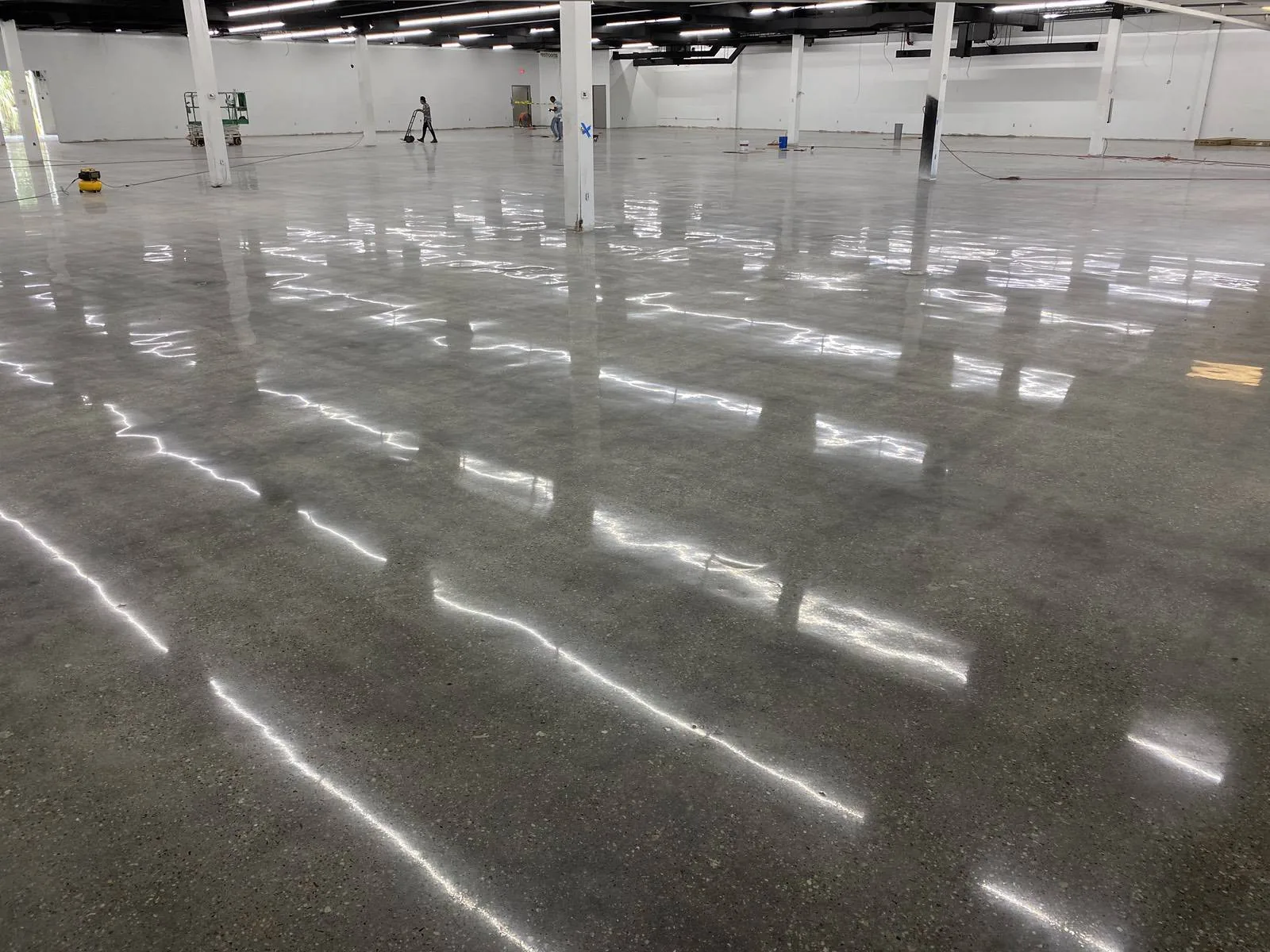
Warehouse floors built for forklifts and long shifts
Distribution and storage floors take wheels, pallets and dropped loads all day. We grind and densify the slab for a polished floor, or lay high-build epoxy where spills and wear call for a coating, then fill the joints and stripe the lanes.
22 years in businessCommercial5.0 on Google from 36 reviews
What it is
A warehouse floor gets judged by forklifts. Hard poly wheels roll the same lanes thousands of times, pallet jacks drag, loads drop off the forks, and every saw-cut joint is a little ledge the wheels hammer on the way across. Racking legs point-load the slab, and a scrubber that runs every night grinds grit into anything soft. Most of the damage we get called to look at starts at those joints, then spreads into spalls and dusting along the drive aisles.
We treat warehouse flooring as an application, and it covers distribution centers, storage buildings, parts rooms and yard shops. For most of them that means grinding the slab, densifying it and polishing it, so the concrete itself becomes the wear surface and nothing can peel. Clean, dry racked storage almost always goes polished. Where there are spills, battery acid, wash-down or a tenant who wants color, we lay a high-build epoxy instead, thick enough to take the traffic. After 22 years on grinders, we build warehouse floors to outlast the lease.
Densifying on its own is a different job, and the difference matters. Densifying is one step: a silicate soaked into the slab to harden the top and stop dust. A warehouse floor is the whole job around it, from the grind and the joint filler to the polish, the guard, the striping and the schedule that keeps your trucks moving while we work. If all you need is a dusting slab hardened, we will tell you that and price the densifier alone. If the aisles are rutted and the joints are chewed, densifier will not fix it, and we will say that too.
Part of our commercial work. See all of it.

Start with the concrete.
What goes down, from the surface you walk on to the slab under it.
We will not roll a thin coat of epoxy on a forklift aisle to hit a price, because the wheels find a thin coating fast.
Polish, guard, stripes
The last pass is a polish and guard or a topcoat, then aisle and safety striping on the cured surface.
Densifier or body coat
A lithium silicate hardens a polished slab, and on a coated floor this layer is the high-build epoxy body coat.
Joint and crack fill
Semi-rigid filler goes into control joints flush with the floor so wheels roll across without slamming the edges.
Grind and profile
Metal-bond diamonds take off old coatings and the weak top, or open a profile epoxy can grab.
Existing slab
Usually a troweled slab with old sealer, tire marks, curing compound and chewed joints, which we map before we price a finish.
Where it belongs
Distribution centers
Long drive aisles and dock doors open to the weather. Polished concrete takes the traffic and scrubs clean overnight.
Racked storage
Rack legs and low spill risk point to a densified polish, with racking set after the floor is done.
Battery and charging rooms
Acid spills eat bare concrete, so charging areas get a chemical-resistant epoxy turned up the wall.
Shop and parts rooms
Oil, hydraulic fluid and dropped parts make solid-color epoxy the practical pick, and a light color brightens the room.
How the crew runs it
Five steps, in order.
Walk the slab
Dustin or Jacob walks the building, checks moisture and joints, and asks where the trucks run and which racks stay put.
Plan the zones
We split the floor into sections around your operations, so one bay is down while the rest of the building keeps shipping.
Grind and fill
Grinders on dust collectors open the slab, then we fill joints and cracks and shave the filler flush.
Densify or coat
A polished floor gets densifier and finer and finer diamond passes. A coated floor gets primer, a high-build body coat and a topcoat.
Stripe and hand back
Once it cures we lay out aisle lines, walkways and stop bars, then walk the floor with your manager before forklifts come back.
For the GC or the facility
- We work in zones around shipping, nights and weekends included, so the building rarely has to shut down.
- A polished floor can usually take traffic once the guard dries. Epoxy typically needs several days of cure before forklifts.
- Submittals, product data and a sample section on request.
- Joint filling waits until the slab has done most of its shrinking, and racking goes in after the floor.
Gulf South conditions
Warehouses along the river and near the ports sit on slabs poured over wet ground, and moisture vapor pushes up through them most of the year. On a polished floor that matters less, because there is no film to lift. Under epoxy it is the first thing we test, since trapped vapor is how blisters start, and a slab that tests high gets a moisture-mitigating primer or a polished finish instead.
Then there is the dock. Open doors in July let humid air roll across a cool slab, the floor sweats near the doors, and a wet polished or coated surface gets slick. We add grit to the topcoat in those zones, run coating work in the cooler, drier hours, and after a storm we check for standing water before anything goes down.
Look at the finish.
“Extraordinary Flooring completed 2 projects for me while I was managing projects for Hilton Worldwide. They were professional, coordinated their work with all operational activities, analytical and proactive when responding to difficult situations.”
Keith Faust, Google review5.0 on Google from 36 reviews
Living with it
Run an auto-scrubber with a neutral cleaner and keep the pads clean. Grit wears a polished floor fastest, so sweep the dock aprons often. Skip acid cleaners and wax strippers on polished concrete, and train drivers to keep the forks up on coated aisles. A dull polish comes back with a burnish and guard long before it needs regrinding.
Next to this one
See finished floorsQuestions about warehouse flooring
See finished jobs in the gallery, or write to the office.
Polished concrete or epoxy for a warehouse?
For dry racked storage and drive aisles we usually recommend polished concrete, because it is the slab itself with nothing to peel. Epoxy makes sense where you have chemicals, battery charging, wash-down or color-coded zones. Plenty of buildings get both, split by area.
Can you work while we keep shipping?
Yes. We section the floor, work around your dock schedule and run nights or weekends where it helps. Our grinders run on dust collectors, so the aisles next door stay clear of concrete dust.
What do you put in the joints?
A semi-rigid filler, poured full and shaved flush so wheels roll across without catching the edge. It supports the joint edges, and that support is what stops spalling. Joints that have already chewed out get their edges rebuilt first.
How is this different from just densifying the floor?
Densifier hardens the top of the slab and cuts dusting, and on a sound floor that may be all you need. A full warehouse floor adds the grind, joint repair, polishing or coating, and striping. We will tell you which one your slab calls for.
Do you do the striping too?
Yes. Once the floor cures we lay out aisle lines, walkways and pallet positions from your layout drawing. Lines go down in a coating made for floor traffic, since ordinary paint wears off under forklift tires.
How do we get a quote?
Send the plans, the square footage and your schedule, or have Dustin come walk the building. We need to see the slab and watch the trucks before we price it. The quote spells out the system and how we phase it.
Let’s look at your floor.
Call with the address and what the floor has to survive. Someone will come look at the slab before anybody talks price.
Bidding a job? Send the plans and the schedule. We price from drawings and walk the slab before we commit to a date.