
What we put down on New Orleans concrete
At 14 miles northeast of Harvey, New Orleans is a normal run for a crew hauling grinders and dust collectors. Commercial jobs get scheduled around your shutdown window, and homeowners get a straight answer on what the slab needs.
New Orleans, Orleans Parish, Louisiana.
What kind of place New Orleans is
Housing figures from the US Census.
Census numbers put the typical home in New Orleans at about 1958. Slabs poured before 1960 were often laid with no vapor barrier at all, straight on the fill. After decades of Gulf humidity, that concrete can push water up into any coating that seals it in.
We test the moisture before we promise anything on a slab that old.
With a rental-heavy housing mix, the person living on the floor is often not the person paying for it. We talk to both and get the owner’s approval in writing before we start.
New Orleans sits in Orleans Parish, inside a stretch of Southeast Louisiana where a lot of ground lies at or below sea level and water management is a fact of every building. Around Orleans Parish, the floor work is mostly this: old slabs under layers of tile and glue, busy restaurant kitchens, hotel service halls and venues that close for one night.
The metro mixes old and new, with raised cottages and shotgun doubles in the older neighborhoods, slab-on-grade ranch houses in the suburbs, and commercial kitchens and warehouses nearly everywhere you look.
Roughly 46% of homes are stand-alone houses; the rest is everything else. Mixed housing usually means mixed slabs. Some are private garages, others are shared walkways and pool areas that need slip resistance and a quick return to service.
Sun on outdoor slabs
The New Orleans metro.
New Orleans is in Orleans Parish, about 14 miles northeast of the shop.
Hurricane season is part of the calendar here, and the metro has a long flood history, with Katrina in 2005 the storm everybody measures by. Slabs that sat under water can carry salts, silt and softened adhesive that all have to come off before anything new goes down. After a flood the floor gets ground back to clean, sound concrete and the cracks and spalls get repaired. Only then does a system go on. Skip that and the coating money is wasted.
Have the slab moisture tested before you pick a system, because in a metro this wet the reading decides between a standard epoxy primer and a moisture-tolerant build.
For a restaurant or commercial kitchen in New Orleans, urethane cement handles hot water, grease and daily washdown far better than a thin epoxy roll coat ever will.
Garage and patio owners should go with a flake or slip-resistant finish, because a glossy floor turns slick fast once humid air or tracked-in rain hits it.
Our picks for New Orleans
Garage Floor Coatings
Flake, solid color, metallic or polished concrete for home garages, ground first so hot tires and oil never lift it.
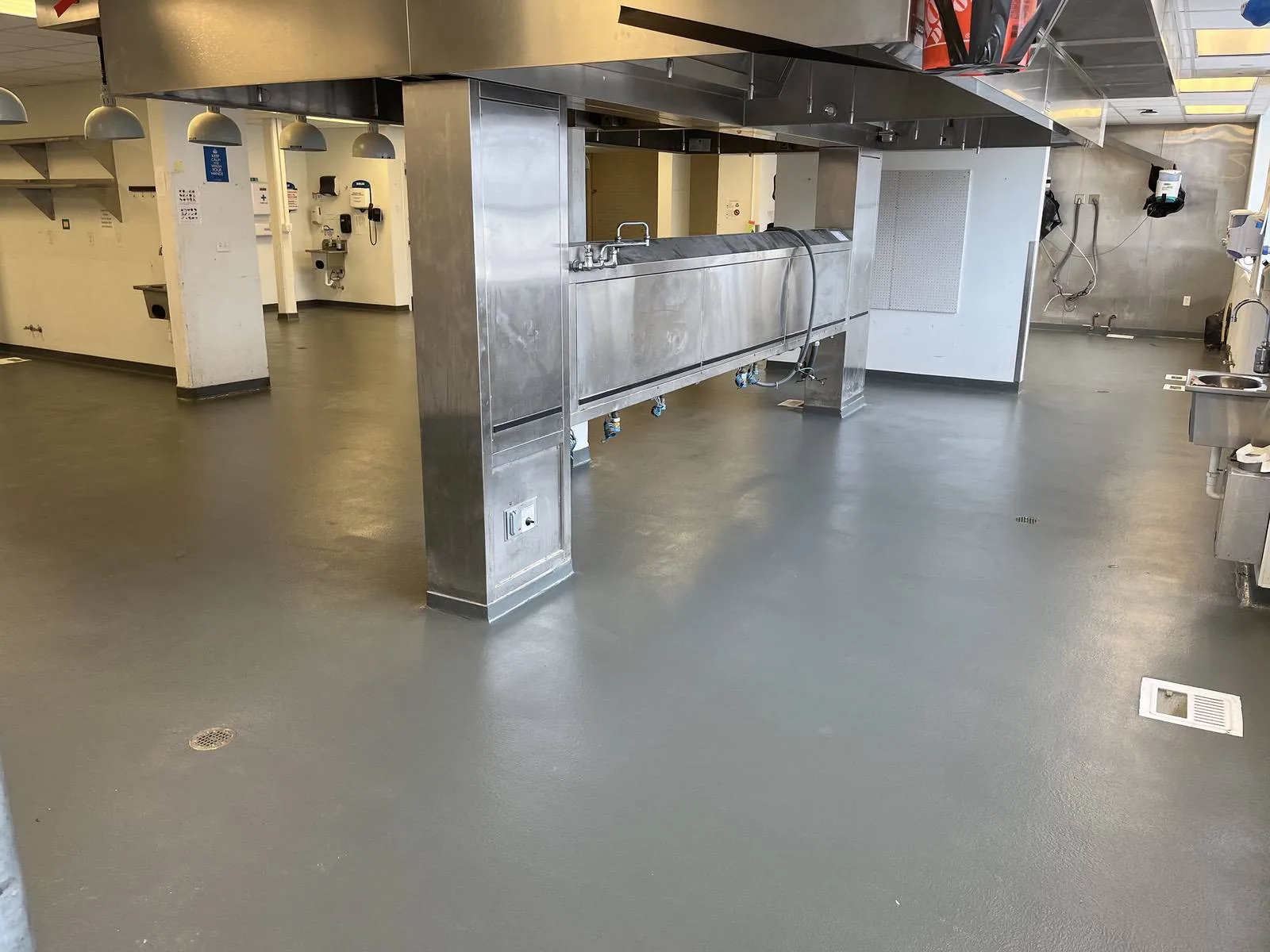
Commercial Kitchen Flooring
Urethane cement and slip-resistant floors with integral cove base for restaurants, school and hotel kitchens, and bars that get mopped every night.
Concrete Restoration
Spall, crack and joint repair, patching, re-leveling and coating removal that puts damaged or flooded slabs back to work.
How any floor here gets built
The same order on every job, whatever the system.
Topcoat or guard, set to the traffic and the shine you want.
The color and the thickness: epoxy, urethane cement, stain or an overlay.
Soaks in and locks the system to the concrete.
Ground or shot blasted until the surface opens up and a coating can bite.
The concrete as we find it. Moisture, old sealer and cracks decide everything above it.
The next towns over
- Chalmette
7.8 miles away, St. Bernard Parish
- Arabi
7.9 miles away, St. Bernard Parish
- Meraux
8.8 miles away, St. Bernard Parish
- Violet
11 miles away, St. Bernard Parish
More in Orleans Parish, on the services page and in the gallery.
New Orleans floor FAQ
Or send the plans first.
Easier to talk it through? Call the shop.
(504) 231-6298Do you come out to New Orleans?
Yes. New Orleans is about 14 miles northeast of our base in Harvey, inside the roughly 100 miles we cover. Someone comes out, looks at the slab and gives you a price after seeing it.
What should I know about a slab from around 1958?
Expect it to have no vapor barrier and several old floor coverings stacked on it. We test for moisture, and for asbestos in any black mastic, before grinding, then plan the prep around what we find.
Can you work around a restaurant that cannot close for long?
That is a normal job here. We plan the grind, the build and the cure around your closed hours or a short shutdown, and some urethane cement systems take traffic sooner than many epoxies. Tell us your window and we will tell you straight whether it fits.
Can a floor that flooded be coated again?
Usually, once the concrete is sound. We grind off the old coating, adhesive and contamination, repair cracks and spalls, and test moisture after the slab has had time to dry. If the concrete itself is damaged, it gets repaired before any coating goes down.
What finish suits an old slab in an older building?
Polished or honed concrete often suits an old slab if it is sound, because it shows the character of the concrete instead of covering it. Heavily patched or uneven slabs may need a micro-topping or an overlay first. We look at the floor before we recommend either.
How do you handle moisture coming up through older metro slabs?
We test the slab before we quote a system. When vapor readings are high, we use a moisture-mitigating primer or a urethane cement built for it instead of hoping a standard epoxy holds. That test costs far less than tearing out a failed floor.
What happens during a site visit?
Dustin walks the slab, looks at the cracks, joints and anything glued or coated to it, and asks what the floor has to handle. Sometimes he runs a quick moisture check in a corner. The quote you get is built on what he saw.
Will the whole floor be out of service at once?
Not always. Larger floors can be done in sections so part of the building stays open, with the order planned around traffic. It takes longer overall, and nobody has to shut down completely.
Where do furniture, cars and equipment go?
Everything comes out of the work area, and cars stay out until the coating cures. For a plant or a kitchen, plan where the equipment sits during the job and when it comes back.
My slab sweats in the summer. Is that a problem?
It means moisture is reaching the surface, from below, from the air or both. We test to see which, then pick a primer and system that can handle it. Coating a sweating slab without that step is how floors peel.
Pick your way in
Tell us the space, the square footage and what goes on the floor. We will tell you which system fits and when we can start.
Send the plans
Facility managers and GCs: send what you have, even a floor plan sketch, and the dates the space can be shut down.