
Concrete floors made for Pass Christian weather
At 58 miles northeast of Harvey, Pass Christian is a normal run for a crew hauling grinders and dust collectors. Commercial jobs get scheduled around your shutdown window, and homeowners get a straight answer on what the slab needs.
Pass Christian, Harrison County, Mississippi.
Old and new construction
Housing figures from the US Census.
The median home in Pass Christian was built around 2002, by the Census count. Slabs poured in the last twenty years are usually flat, dense and well reinforced, and some are post-tensioned. That makes them good candidates for polished concrete.
It also means we stay off the cables and grind only the surface.
Pass Christian is on the Gulf Coast in Harrison County, Mississippi, where salt air, hurricane history and twenty years of rebuilding since Katrina shape the buildings near the water.
Most homes here are stand-alone houses, about 85 in every 100. When nearly every home is a house, the driveway counts as a floor too. Concrete that has cracked or stained out front can be repaired and coated with something built for sun and rain.
Numbers like these are why we ask what the space is used for before we talk systems.
Shipbuilding at Pascagoula, the port at Gulfport and the port of Mobile put a lot of industrial floor work on this coast, from fab shops to big warehouses. Around Harrison County, the floor work is mostly this: casino back-of-house, port and warehouse slabs, and the homes behind the seawall, all breathing salt air off the Sound. The nearest towns on our list range from Long Beach (typical home around 1982) to Henderson Point (around 2006); Pass Christian lands on the newer side.
Storm season and concrete
The Mississippi Gulf Coast.
Pass Christian is in Harrison County, about 58 miles northeast of the shop.
Katrina came ashore near the Louisiana and Mississippi line in 2005 and pushed surge across the whole coast, from Waveland and Bay St. Louis through Biloxi to Pascagoula and on into Mobile. Much of the coast was rebuilt afterward, with houses raised and businesses redone or moved. That leaves post-storm slabs beside older floors that once sat under salt water. Those older floors get ground to clean concrete, tested and repaired before anything goes over them.
For a casino, hotel or restaurant, pick a system that can go down and take traffic between closing and reopening, and book that window early.
Outdoor slabs need a UV-stable topcoat and a lighter color, since coastal sun yellows plain epoxy and a dark deck gets too hot for bare feet.
Have the crew sound out dock edges, stair landings and patios near the water with a hammer, because salt-damaged concrete often rings hollow before it looks bad.
Good picks for this city
Garage Floor Coatings
Flake, solid color, metallic or polished concrete for home garages, ground first so hot tires and oil never lift it.
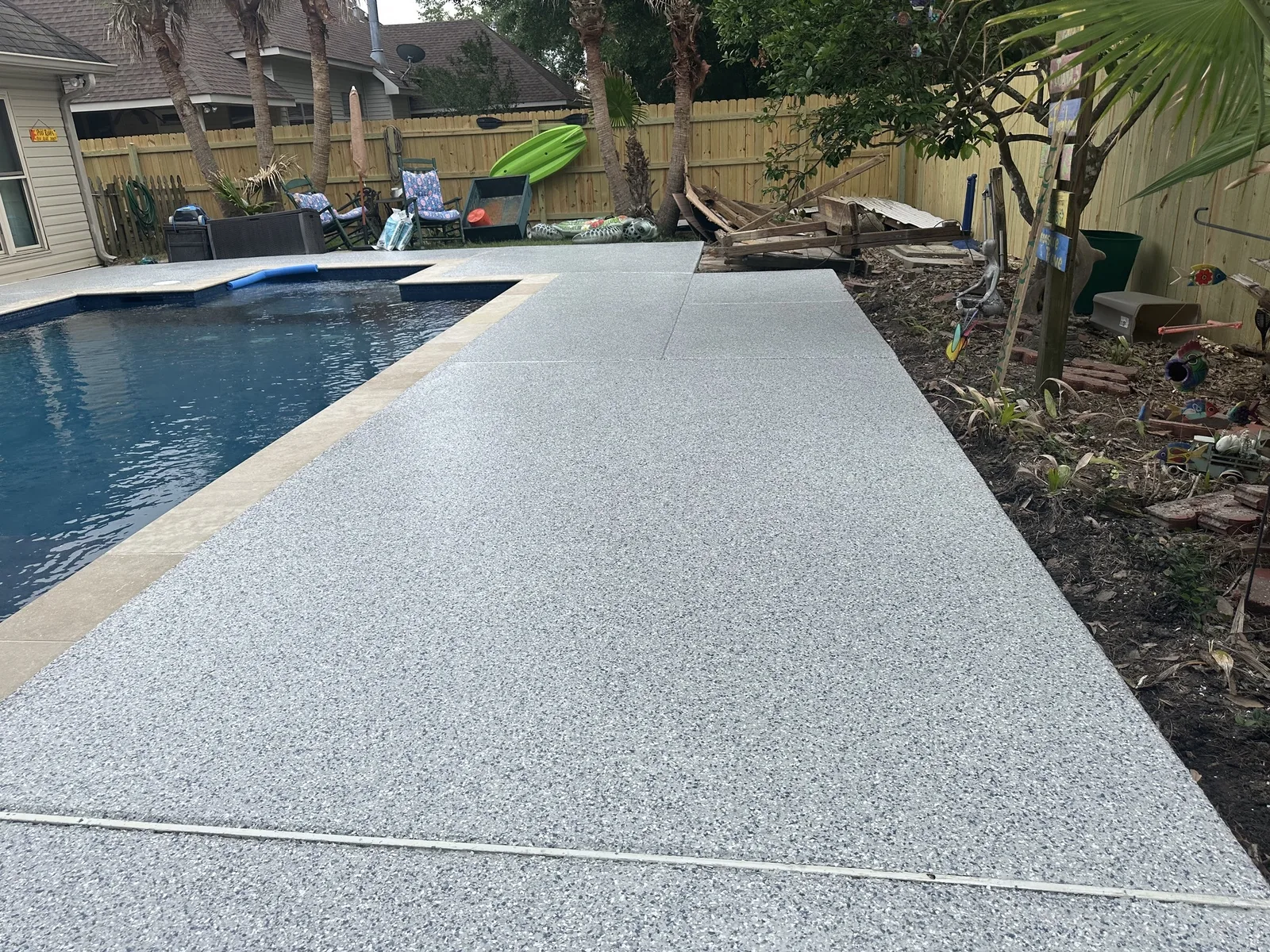
Pool Deck Coatings
Textured overlays and flake decks in light, cooler colors, sealed with grit and built to live with chlorine, salt and wet feet.

Patio Coatings
Overlays, stamped patterns and stain for covered and open patios and porches, finished with a topcoat that grips in the rain.
How any floor here gets built
The same order on every job, whatever the system.
Topcoat or guard, set to the traffic and the shine you want.
The color and the thickness: epoxy, urethane cement, stain or an overlay.
Soaks in and locks the system to the concrete.
Ground or shot blasted until the surface opens up and a coating can bite.
The concrete as we find it. Moisture, old sealer and cracks decide everything above it.
The next towns over
- Henderson Point
2.8 miles away, Harrison County
- DeLisle
5 miles away, Harrison County
- Long Beach
5.2 miles away, Harrison County
- Bay St. Louis
7.1 miles away, Hancock County
More in Harrison County, on the services page and in the gallery.
Pass Christian floor FAQ
Or send the plans first.
Got a slab question we did not cover? Call.
(504) 231-6298Do you come out to Pass Christian?
Yes. Pass Christian is about 58 miles northeast of our base in Harvey, inside the roughly 100 miles we cover. Someone comes out, looks at the slab and gives you a price after seeing it.
What should I know about a slab from around 2002?
Expect a few shrinkage cracks from the first year or two. They have usually stopped moving and fill cleanly before coating or polishing.
Can you coat the ground-level slab under an elevated house in Pass Christian?
Yes, and that slab does a lot of work as parking, storage or a shop. A flake or broadcast system bonds well to it and hoses clean after a storm. We test moisture first, because ground-level concrete near the coast often stays damp.
Can you coat casino or hotel floors without shutting them down?
Usually, by working in sections overnight or in the slow hours and picking systems that cure in time to reopen. We plan the phases with the property before we start. If a system cannot cure inside the window, we tell you that up front.
Do you do floors for shipyards and port warehouses?
Yes. Fab shops and port warehouses take steel, forklifts and oil, so they get thick troweled or broadcast systems over a shot-blasted slab. Send the loads, the chemicals and the work schedule and we will price it.
How should the floor look when Dustin arrives?
Clear enough to see bare concrete in a few spots. If the slab is under carpet or tile, pull back a corner where you can. Ten seconds of looking at the real surface tells us more than any description.
Can you work around our business hours?
Commercial jobs often run nights, weekends or inside a planned shutdown window. Tell us when the floor has to be back in service and we build the sequence backward from that date.
Should I clean the slab before you arrive?
Sweep it if you like, but the grinder does the real cleaning. Tell us about oil spots, chemical spills or anything soaked into the concrete so we can plan for it.
After a flood, how soon can a floor be coated?
Not until the slab has dried out and been tested. Flood water leaves salts and silt in the concrete, so we grind deeper and check moisture before committing to a coating. Rushing it is how a new floor fails a year later.
Two ways to start
Five minutes on the phone usually tells us whether it is a grind and seal, a coating or a polish.
Send the plans
Facility managers and GCs: send what you have, even a floor plan sketch, and the dates the space can be shut down.