
Floors that hold up to Garyville humidity
Drive 36 miles west of Harvey and you reach Garyville, where a floor from our crew gets the same grind and the same cure times as one next door to the shop.
Garyville, St. John the Baptist Parish, Louisiana.
Old and new construction
Housing figures from the US Census.
Census numbers put the typical home in Garyville at about 1970. Most 1970s slabs were poured to sit under carpet or vinyl. Strip that away and you get plain, rough concrete.
Ground and polished, it shows its age, which some owners like and others cover with a solid-color coating instead.
Floor work around Garyville often answers to industrial standards, since plant owners and their contractors expect submittals, safety plans and work that fits inside a shutdown window. Around St. John the Baptist Parish, the floor work is mostly this: storm-repaired homes and shops in LaPlace, plant and warehouse floors near Garyville and Reserve, and patios on the Edgard side.
Homes along the corridor range from older raised houses near the levee to newer slab-on-grade subdivisions set back from the river, so residential slabs vary as much as the commercial ones.
Stand-alone houses make up the bulk of it, roughly 86%. Single-family homes dominate, so most floor work starts in a garage or out back. Commercial floors in a place like this tend to be shops, restaurants and small offices.
That mix decides who calls: owners redoing a garage or patio, landlords between tenants, or a business with a shop or a kitchen.
Storm season and concrete
The River Parishes.
Garyville is in St. John the Baptist Parish, about 36 miles west of the shop.
The river corridor gets the same wet heat and heavy rain as the rest of Southeast Louisiana, and the low ground near the river and the swamps behind it holds water. On-grade slabs push moisture vapor up into whatever covers them. A moisture test comes before any system gets picked. Where the readings run high, a moisture-tolerant primer or a urethane cement goes down first, and the finish system goes on top of that.
On older commercial slabs, plan time for removing what is already there, because old coatings and mastic are often the biggest part of the job.
Book floor work into a turnaround or shutdown window early, since the crew, the materials and the cure time all have to fit inside dates the plant sets.
If a plant floor in Garyville sees chemicals, hand us the list of what gets spilled, because that list decides which resin we spec for the room.
What to put down here
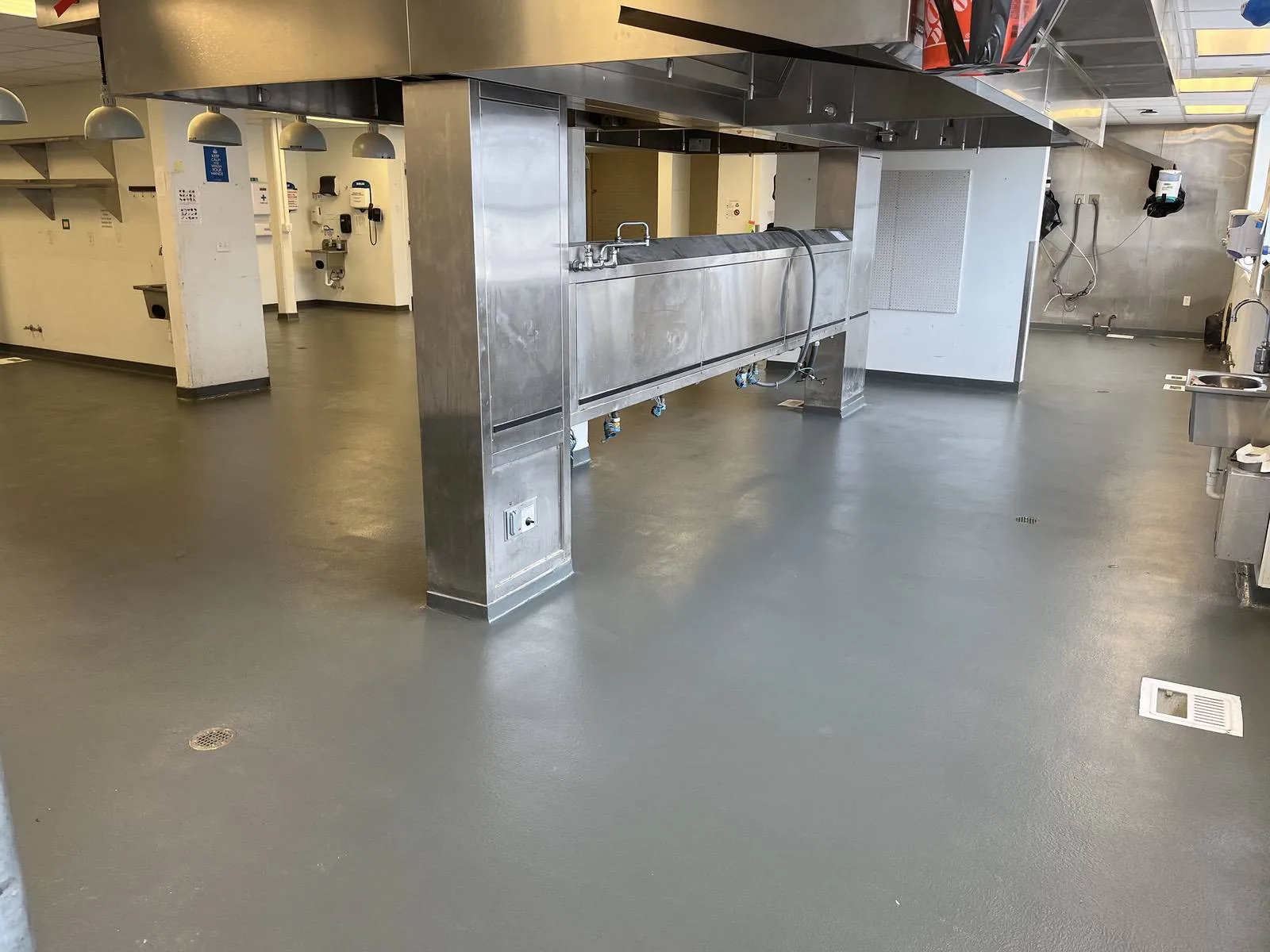
Industrial Flooring
Plants, process areas, shops and support buildings along the river and coast, zoned by use and installed around shutdown windows.
Garage Floor Coatings
Flake, solid color, metallic or polished concrete for home garages, ground first so hot tires and oil never lift it.

Patio Coatings
Overlays, stamped patterns and stain for covered and open patios and porches, finished with a topcoat that grips in the rain.
How any floor here gets built
The same order on every job, whatever the system.
Topcoat or guard, set to the traffic and the shine you want.
The color and the thickness: epoxy, urethane cement, stain or an overlay.
Soaks in and locks the system to the concrete.
Ground or shot blasted until the surface opens up and a coating can bite.
The concrete as we find it. Moisture, old sealer and cracks decide everything above it.
The next towns over
- Wallace
3.2 miles away, St. John the Baptist Parish
- Gramercy
3.5 miles away, St. James Parish
- Lutcher
4.6 miles away, St. James Parish
- Reserve
4.8 miles away, St. John the Baptist Parish
More in St. John the Baptist Parish, on the services page and in the gallery.
Do you come out to Garyville?
Yes. Garyville is about 36 miles west of our base in Harvey, inside the roughly 100 miles we cover. Someone comes out, looks at the slab and gives you a price after seeing it.
What should I know about a slab from around 1970?
Some 1970s slabs have a thin plastic vapor barrier and some have none, so a moisture test tells us which one you have. Sheet vinyl and its adhesive are common on top and grind off slowly.
Do you take residential work along the river?
Yes, garages, patios, shops and interiors. Homeowners get the same moisture test and grinding a commercial floor gets, because the slab does not care who owns it.
Do you work at plants and refineries along the river?
Yes. Industrial and plant floors are a big part of what we do, and we work to whatever safety rules and work permits the site requires. Send the scope, the chemical exposure and the shutdown dates, and we will price a system that fits.
Can you finish a floor during a short plant shutdown?
Often, if we plan it before the shutdown starts. We stage materials, run grinding and coating back to back, and pick systems whose cure fits the dates. If the window is too tight for the system you need, we say so up front.
What do you do about moisture in river-country slabs?
We test every slab before we spec a system. High vapor readings call for a moisture-mitigating primer or urethane cement, both of which tolerate conditions that make a standard epoxy blister.
How long does a typical floor take?
A two-car garage usually takes one to two days of work plus cure time. Bigger commercial floors depend on square footage, the system and how much prep the slab needs, and the schedule comes with the quote.
Do I need to remove the old flooring myself?
No. Pulling carpet, tile or glue is part of our prep, and it is priced in. Some owners pull carpet themselves to save time, which is fine as long as the tack strips and pad come up too.
What does humidity do to a fresh coating?
Put down at the wrong moment, some coatings can turn cloudy or stay tacky at the surface. We read the dew point and slab temperature before we mix, and we hold off when the numbers are wrong.
Two ways to start
Tell us the space, the square footage and what goes on the floor. We will tell you which system fits and when we can start.
Send the plans
General contractors: send drawings, square footage, finish schedule and the window you have. Submittals and samples on request.