
What we put down on New Sarpy concrete
If you run a business or own a home in New Sarpy, the floor question starts the same way: what is under the old finish, and how wet is the slab? We find that out before we quote. It sits in St. Charles Parish, about 20 miles west of Harvey.
New Sarpy, St. Charles Parish, Louisiana.
How New Sarpy is built
Housing figures from the US Census.
Census numbers put the typical home in New Sarpy at about 1963. Sixties-era slabs in the Gulf South have lived through more than one major storm. If water got in, look for white efflorescence pushed up through the concrete along the walls and low spots.
That salt has to come off, or the coating will lift right where it sits.
Floor work around New Sarpy often answers to industrial standards, since plant owners and their contractors expect submittals, safety plans and work that fits inside a shutdown window.
Most homes here are stand-alone houses, about 77 in every 100. When nearly every home is a house, the driveway counts as a floor too. Concrete that has cracked or stained out front can be repaired and coated with something built for sun and rain.
Numbers like these are why we ask what the space is used for before we talk systems.
Homes along the corridor range from older raised houses near the levee to newer slab-on-grade subdivisions set back from the river, so residential slabs vary as much as the commercial ones. Around St. Charles Parish, the floor work is mostly this: plant control rooms, maintenance shops and warehouses on the river, plus garages and patios in Luling, Destrehan and St. Rose. The nearest towns on our list range from Norco (typical home around 1962) to Hahnville (around 1988); New Sarpy lands on the older side.
Sun on outdoor slabs
The River Parishes.
New Sarpy is in St. Charles Parish, about 20 miles west of the shop.
The river corridor gets the same wet heat and heavy rain as the rest of Southeast Louisiana, and the low ground near the river and the swamps behind it holds water. On-grade slabs push moisture vapor up into whatever covers them. A moisture test comes before any system gets picked. Where the readings run high, a moisture-tolerant primer or a urethane cement goes down first, and the finish system goes on top of that.
Book floor work into a turnaround or shutdown window early, since the crew, the materials and the cure time all have to fit inside dates the plant sets.
If a plant floor in New Sarpy sees chemicals, hand us the list of what gets spilled, because that list decides which resin we spec for the room.
On older commercial slabs, plan time for removing what is already there, because old coatings and mastic are often the biggest part of the job.
Kitchens and plant floors
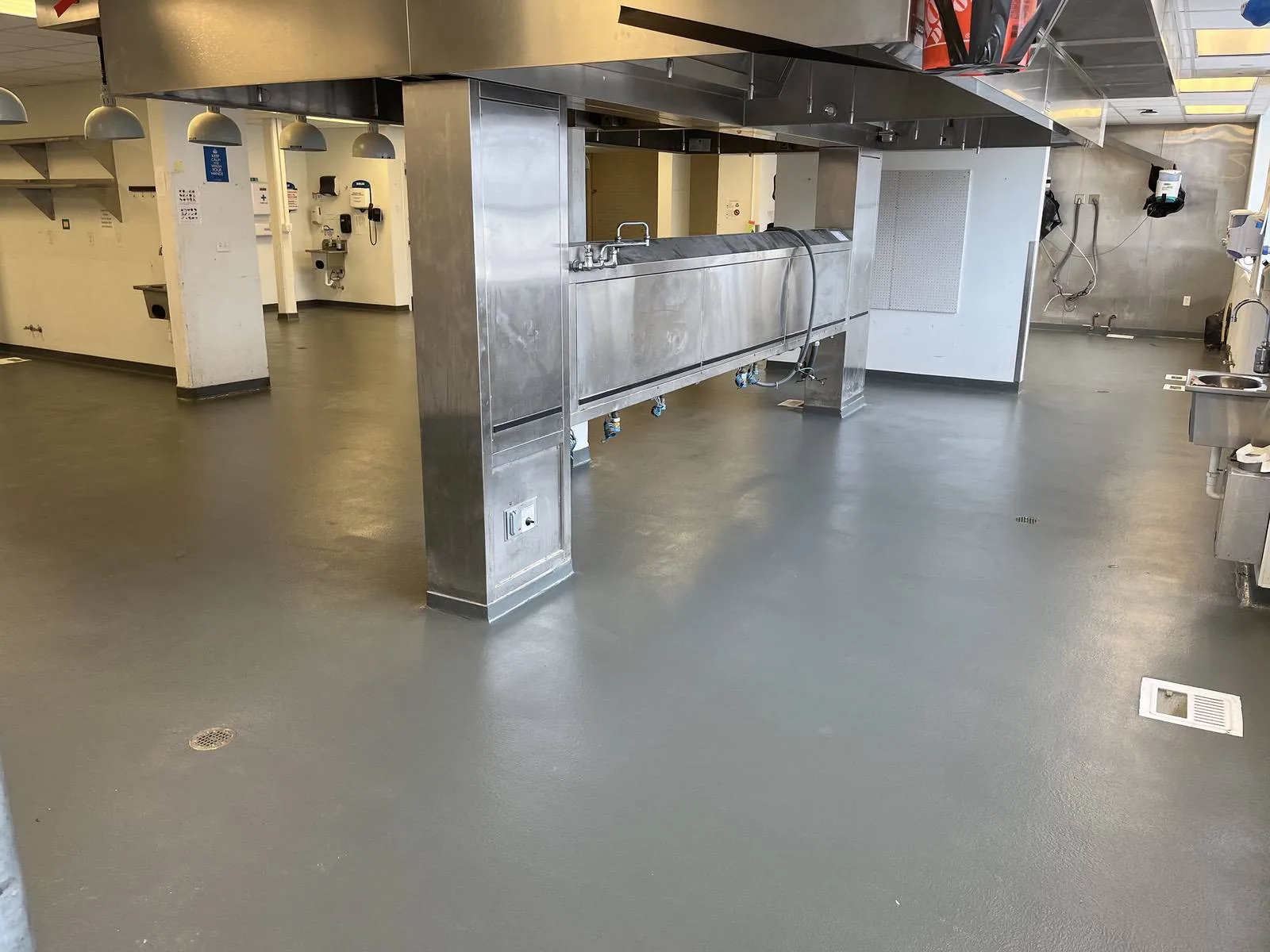
Industrial Flooring
Plants, process areas, shops and support buildings along the river and coast, zoned by use and installed around shutdown windows.
Garage Floor Coatings
Flake, solid color, metallic or polished concrete for home garages, ground first so hot tires and oil never lift it.
Concrete Restoration
Spall, crack and joint repair, patching, re-leveling and coating removal that puts damaged or flooded slabs back to work.
How any floor here gets built
The same order on every job, whatever the system.
Topcoat or guard, set to the traffic and the shine you want.
The color and the thickness: epoxy, urethane cement, stain or an overlay.
Soaks in and locks the system to the concrete.
Ground or shot blasted until the surface opens up and a coating can bite.
The concrete as we find it. Moisture, old sealer and cracks decide everything above it.
The next towns over
- Destrehan
1.8 miles away, St. Charles Parish
- Norco
1.8 miles away, St. Charles Parish
- Hahnville
2.7 miles away, St. Charles Parish
- Taft
4.1 miles away, St. Charles Parish
More in St. Charles Parish, on the services page and in the gallery.
Quick answers before a visit
Or send the plans first.
Got a slab question we did not cover? Call.
(504) 231-6298Do you come out to New Sarpy?
Yes. New Sarpy is about 20 miles west of our base in Harvey, inside the roughly 100 miles we cover. Someone comes out, looks at the slab and gives you a price after seeing it.
What should I know about a slab from around 1963?
Concrete this age is often dense and well cured under the grime. Once it is ground clean, it takes epoxy or polish well, though patches will show through a polished finish.
Can you finish a floor during a short plant shutdown?
Often, if we plan it before the shutdown starts. We stage materials, run grinding and coating back to back, and pick systems whose cure fits the dates. If the window is too tight for the system you need, we say so up front.
Do you take residential work along the river?
Yes, garages, patios, shops and interiors. Homeowners get the same moisture test and grinding a commercial floor gets, because the slab does not care who owns it.
Do you work at plants and refineries along the river?
Yes. Industrial and plant floors are a big part of what we do, and we work to whatever safety rules and work permits the site requires. Send the scope, the chemical exposure and the shutdown dates, and we will price a system that fits.
What floor holds up to chemical spills?
Urethane cement and chemical-resistant epoxies, installed thick over a properly prepared slab. Which one depends on the chemicals, the temperatures and the cleaning routine. We match the resin to your exposure list rather than guessing.
What happens during a site visit?
Dustin walks the slab, looks at the cracks, joints and anything glued or coated to it, and asks what the floor has to handle. Sometimes he runs a quick moisture check in a corner. The quote you get is built on what he saw.
When can I walk on it?
Light foot traffic is typically fine within a day on most coatings, and full cure takes longer. We give you the timing for your system, because urethane cement, epoxy and polished concrete all behave differently.
Should I clean the slab before you arrive?
Sweep it if you like, but the grinder does the real cleaning. Tell us about oil spots, chemical spills or anything soaked into the concrete so we can plan for it.
My slab sweats in the summer. Is that a problem?
It means moisture is reaching the surface, from below, from the air or both. We test to see which, then pick a primer and system that can handle it. Coating a sweating slab without that step is how floors peel.
Pick your way in
Call with the address and what the floor has to survive. Someone will come look at the slab before anybody talks price.
Send the plans
Bidding a job? Send the plans and the schedule. We price from drawings and walk the slab before we commit to a date.