
Pull a car in off hot asphalt in July and the tires come in soft and sticky. Park it on a slab that sweats every humid morning and the floor is wet from both sides. A garage floor down here gets judged on that before anybody picks a color.
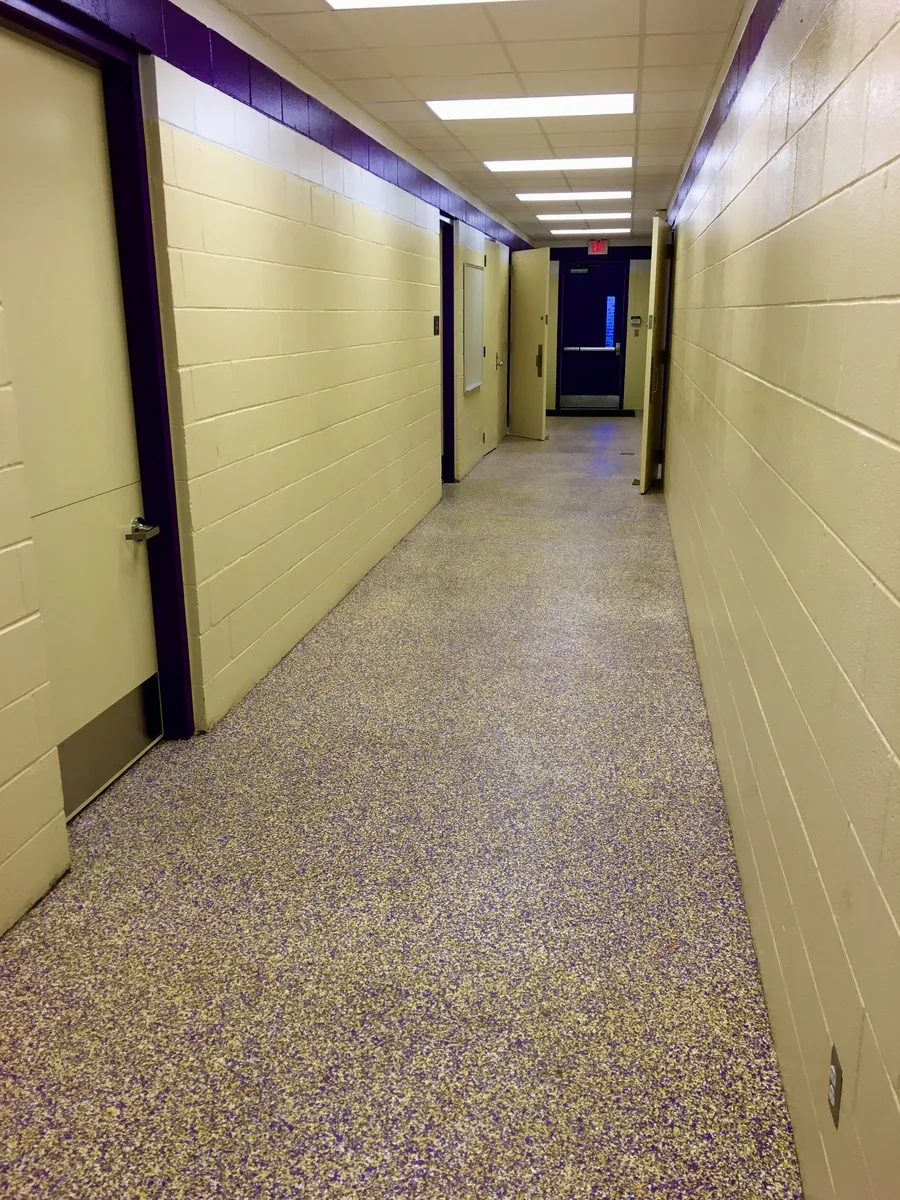
What hot tires do to a weak coating
Hot tire pickup is the failure people see first. Tires coming off a summer road are hot, and the rubber softens. Park on a thin coating and the tire grips it while it sits. When the car backs out, it pulls a patch of coating off with it, usually in the shape of a tread. Thin paint and one-day kits rolled onto a slab that was only acid washed are where this happens most.
Color has nothing to do with it. A flake floor and a solid floor both hold up under hot tires when the slab is ground to a real profile and the system goes down at real thickness with a topcoat built for it. Both peel when it is not. Start the decision there, then argue about looks.
The flake floor, from the slab up
A flake floor is a coating with vinyl chips broadcast into it. We grind the slab, fill cracks and spalls, and put down a base coat. While that coat is wet, the crew throws flake by hand across the whole floor until no more will stick, which the trade calls broadcasting to refusal. Once it cures, the loose flake gets swept and scraped off, and one or two clear topcoats lock the rest in.
The flake does real work. It adds body, it gives the surface texture under a wet shoe, and its speckle hides dust, sand, tire marks and small scratches. Blends run from quiet grays to busy mixes with three or four colors. A partial broadcast, with flake scattered lighter over a solid base, sits between the two looks.
- Ground slab, cracks and spalls filled
- Base coat in a color close to the blend
- Vinyl flake broadcast to refusal
- Loose flake scraped and vacuumed off
- Clear topcoat, one or two coats
The solid color floor
A solid floor skips the flake. The slab gets the same grind and repair, then a primer, a pigmented body coat and a topcoat. It looks clean and sharp, like the floor in a dealership service bay. It also shows everything: dust blown in under the door, white tire marks, a scuff where the bike stand drags, and every scratch from a dropped wrench.
That last part cuts both ways. On a solid floor, a dropped screw or washer is easy to find, which is why plenty of people who work in their garage pick it. Grays hide more than whites and blacks. If you want a solid floor with grip, we can broadcast a fine aggregate into the topcoat.
A solid floor hides the slab under it better than people expect. A body coat at the right thickness covers patched cracks, while a thin one shows every repair.
Rain, water and grip
Louisiana rain comes in sideways and comes off the car in sheets. A garage floor spends a lot of its life with water on it, and a glossy smooth coating gets slick when wet. Flake gives some texture on its own. Add a fine grit to the topcoat and both systems grip far better, at the cost of a little more effort with the mop.
Water also finds the edges. Where the floor meets the driveway at the door, rain and grit run in, and a coating that stops short or stops thin starts lifting there first. We grind a clean edge at the door and carry the system out to it at full thickness.
Humidity and the slab under it
Garage slabs are often poured on fill with no vapor barrier, and many sit beside a lawn that gets watered every evening. Vapor moving up through that slab pushes against any film on top. Coat it without checking and you can get blisters weeks or months later. We test before we coat, and on a slab that reads high we put down a moisture mitigating primer first.
Install day has its own humidity problem. On a muggy morning a cool slab can carry a film of condensation nobody can see, and primer laid on it will not bond. Some topcoats also set faster in wet air, which shortens the time the crew has to work a batch. We check the slab against the dew point, mix to the weather, and when it is too wet, we wait a few hours.
Sun at the door
The first few feet inside the garage door get full sun every time the door is up. Standard epoxy can amber and yellow in sunlight, which shows most on a light solid color and least on a busy flake blend. That is why we finish garages with a topcoat that holds its color in UV, a polyaspartic or a urethane, over the epoxy base. The base does the heavy lifting and the topcoat takes the sun.
Inside, out of the sun, a plain epoxy topcoat is fine, and some people pick it for a workshop because it is hard and easy to recoat.
How we would call it
For most working garages in the Gulf South, we steer people to flake. It hides the dirt that blows in, grips better wet, shrugs off small scratches and looks good years later with nothing but a hose and a push broom. For a garage that doubles as a show space, a clean workshop, or a room where finding a dropped part matters, a solid color with a grit topcoat makes sense.
Either way, the build matters more than the finish. Dustin can come look at the slab, check it for moisture and cracks, show you flake blends and solid color chips in your own light, and tell you which system we would put down.
Questions
How soon can I park on a new garage floor?
Foot traffic usually comes back within a day, and cars take longer because hot tires and turning wheels are hard on a fresh topcoat. The topcoat’s data sheet and the temperature set the real number, so we give you the day for your system before we start. Wait the full time, even if the floor looks done.
Can you coat over the paint or kit already on my garage floor?
We grind it off first. A new system bonds to whatever is under it, and an old coating that is already peeling or barely holding on will take the new floor with it. Bare, profiled concrete is the only thing we coat.
Will the cracks in my slab show through?
We fill cracks before we coat, and flake hides a filled crack well. A crack that is still moving, from a settling slab or a corner that rocks, can come back through any coating. We tell you which cracks look stable and which ones we would watch.
Is a flake floor hard to clean?
No. A push broom and a hose handle most of it, and a mop with a mild cleaner handles the rest. With a grit topcoat, use a deck brush on the heavy spots. Skip harsh solvents and keep battery acid off the floor.
Someone looks at the slab, or the plans, before anybody talks price. Call the office at (504) 231-6298, email extraordinaryflooringllc@gmail.com, send the plans, or see the gallery first.