
Houses or warehouses, McLain gets the same crew
Older buildings and new subdivisions sit side by side in a lot of Gulf towns, so a slab in McLain can be anything from clean and bare to coated three times over. We sort that out first. It sits in Greene County, about 112 miles northeast of Harvey.
McLain, Greene County, Mississippi.
Where McLain sits
Housing figures from the US Census.
Census numbers put the typical home in McLain at about 1983. Shops and warehouses from this era were usually built with thicker slabs and sawn joints. That makes them good candidates for polished concrete or a thick urethane system.
The joints need a semi-rigid filler so forklift wheels do not chip the edges.
Floors in McLain deal with long humid summers, heavy rain and the occasional Gulf storm that arrives still carrying plenty of wind and water.
It is a mix: about 54% stand-alone houses, the rest townhomes, condos, mobile homes and apartments. With a fair share of townhomes and apartments alongside the houses, shared floors come into play. Those jobs run on a schedule that keeps residents moving, often one section at a time.
We read those numbers the way we read a slab: they say whether to expect garages, rentals or commercial floors before we drive out.
McLain is in Greene County, Mississippi, in the Pine Belt, where pine timber, red clay roads and loaded log trucks have been part of the scenery for generations. Around Greene County, the floor work is mostly this: equipment sheds, mill and shop floors, rural churches and garages, where the fix often starts with crack repair and a moisture reading. The nearest towns on our list range from Wiggins (typical home around 1971) to Beaumont (around 1998); McLain lands on the older side.
Sun on outdoor slabs
The Pine Belt.
McLain is in Greene County, about 112 miles northeast of the shop.
Clay ground can move as it wets and dries, so cracked slabs are common in older buildings, and some of those cracks are still moving. We check whether a crack is active before deciding how to fill it. Hospitals, universities and schools ask for floors that clean easily and stay down for years. Mills, timber equipment shops and barns want thick, rough service floors that take mud and steel without lifting.
For a mill or timber equipment shop, go thick with a troweled or broadcast system, because skidder parts, chain and mud wear out roll-on coatings in a season.
Before filling a crack in an older slab, have it checked for movement, since a rigid filler in a crack that still moves will open right back up.
Plan a hospital or clinic floor with the infection control team early, because the work zone, dust control and cure times all have to suit a building that never closes.
Kitchens and plant floors
Garage Floor Coatings
Flake, solid color, metallic or polished concrete for home garages, ground first so hot tires and oil never lift it.

Concrete Polishing
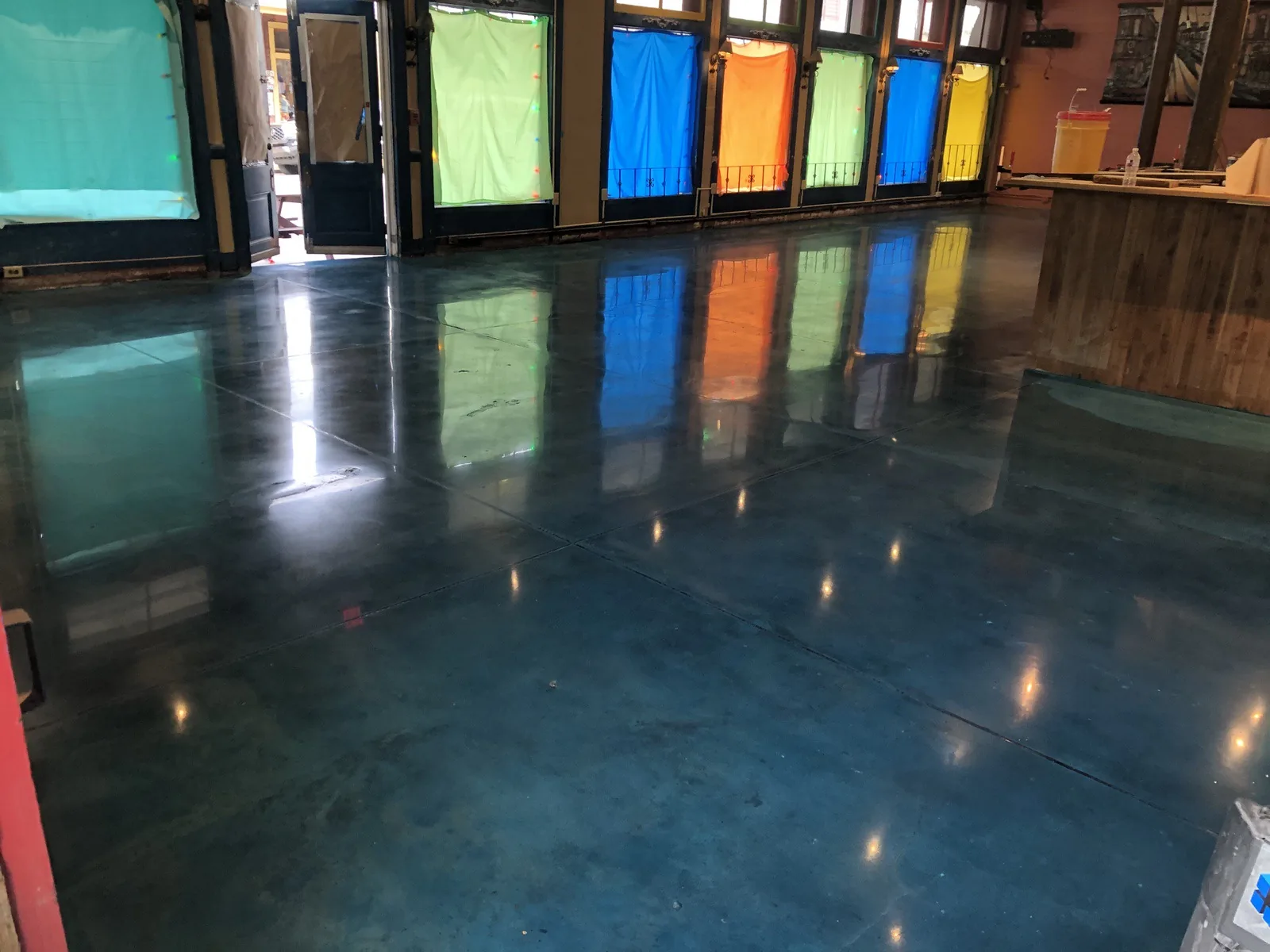
Mechanical grind and polish of the existing slab, densified and guarded, for showrooms, warehouses, restaurants and offices that want a bright floor.
Retail Flooring
Polished, stained or metallic epoxy floors for stores, showrooms and restaurants, installed on night shifts and between tenants.
How any floor here gets built
The same order on every job, whatever the system.
Topcoat or guard, set to the traffic and the shine you want.
The color and the thickness: epoxy, urethane cement, stain or an overlay.
Soaks in and locks the system to the concrete.
Ground or shot blasted until the surface opens up and a coating can bite.
The concrete as we find it. Moisture, old sealer and cracks decide everything above it.
The next towns over
- Leaf
4.9 miles away, Greene County
- Beaumont
8 miles away, Perry County
- New Augusta
14 miles away, Perry County
- Benndale
16 miles away, George County
More in Greene County, on the services page and in the gallery.
Common questions
Or send the plans first.
Want a straight answer today? Ring the office.
(504) 231-6298Do you come out to McLain?
Yes. McLain is about 112 miles northeast of our base in Harvey, inside the roughly 100 miles we cover. Someone comes out, looks at the slab and gives you a price after seeing it.
What should I know about a slab from around 1983?
It may have been through more than one big storm. We check the wall edges and low spots for water damage and salt before choosing a system.
Do you put down floors in hospitals and medical offices around McLain?
Yes, healthcare is one of the kinds of work we take first. Those floors need easy cleaning, slip resistance and often cove base, and the work has to fit the facility’s infection control rules and hours. Samples and product data are available for submittals.
Can you work in a school or university building between terms?
Yes. Breaks between terms are when most campus and school floors get done, since the grind is loud and dusty and the cure needs empty rooms. Book the dates early so the crew and materials are lined up before students leave.
What floor works in a sawmill shop or timber equipment barn?
A thick troweled epoxy, urethane cement or heavy broadcast system over a ground or shot-blasted slab. Mud, chain, hydraulic oil and steel tracks wear through thin coatings fast. Coarse texture keeps it walkable when it is wet.
Can you quote from photos or plans instead of a visit?
For commercial jobs, drawings, square footage and a schedule are often enough to price the work, with a look at the slab before we start. For homes, photos help, but we want to see the concrete in person before we commit to a system.
What can push a schedule back?
Moisture in the slab, surprises under old flooring and rain on outdoor jobs. We test early and look under the old floor during the visit, so most of that shows up before the dates are set.
Does anyone need to be home during the work?
Only for access at the start and a walkthrough at the end, unless you want to watch. Grinding is loud, so pets and kids are better off somewhere else that day.
What does humidity do to a fresh coating?
Put down at the wrong moment, some coatings can turn cloudy or stay tacky at the surface. We read the dew point and slab temperature before we mix, and we hold off when the numbers are wrong.
Pick your way in
Call with the address and what the floor has to survive. Someone will come look at the slab before anybody talks price.
Send the plans
General contractors: send drawings, square footage, finish schedule and the window you have. Submittals and samples on request.