
Kitchens and shops in Village St. George need harder floors
If you run a business or own a home in Village St. George, the floor question starts the same way: what is under the old finish, and how wet is the slab? We find that out before we quote. It sits in East Baton Rouge Parish, about 68 miles northwest of Harvey.
Village St. George, East Baton Rouge Parish, Louisiana.
Census facts for Village St. George
Housing figures from the US Census.
The median home in Village St. George was built around 1985, by the Census count. Slabs from the 1980s are usually in better shape than older ones, with a vapor barrier more often in place and finishing done with power trowels. That smooth, dense surface is good news for polish.
It is harder news for coatings, which need the grinder to open it up first.
We read those numbers the way we read a slab: they say whether to expect garages, rentals or commercial floors before we drive out.
Village St. George sits in East Baton Rouge Parish, part of the Baton Rouge area, which takes in the state capital, the plants strung along the river and a ring of fast-growing suburbs. Around East Baton Rouge Parish, the floor work is mostly this: plant floors, school kitchens, storefronts and flood-soaked houses around Baton Rouge, each one tested for moisture before anything goes down.
Around Baton Rouge the Mississippi is lined with refineries, chemical plants and terminals, and the shops, warehouses and contractors that serve them fill the roads behind the levee.
Most homes here are stand-alone houses, about 86 in every 100. In a community of mostly houses, the interior slab under old carpet or tile is worth a look. Ground and polished, it makes a hard floor that stays cool underfoot through Gulf summers.
What the weather does to a slab
The Baton Rouge area.
Village St. George is in East Baton Rouge Parish, about 68 miles northwest of the shop.
In August 2016 days of rain pushed the Amite and Comite rivers out of their banks and flooded a wide stretch of the capital area. Floors that sat under that water came up with ruined tile, swollen wood and slabs carrying silt. A slab that got covered back over in a hurry during the rebuild can still hide that residue. When we take up a floor like that, we grind down to clean concrete, test the moisture and repair what the water left before any new system goes on.
If the building took water in 2016, plan on pulling up whatever went down afterward and testing the concrete underneath before choosing a new system.
Polished concrete suits a lot of older retail space in the capital area, provided the slab is still sound once the old tile and glue come off.
For a plant floor, tell us what rolls across it and what gets spilled on it, because wheel loads and chemicals decide both the resin and the thickness.
Choosing a floor for Village St. George
Garage Floor Coatings
Flake, solid color, metallic or polished concrete for home garages, ground first so hot tires and oil never lift it.

Patio Coatings
Overlays, stamped patterns and stain for covered and open patios and porches, finished with a topcoat that grips in the rain.
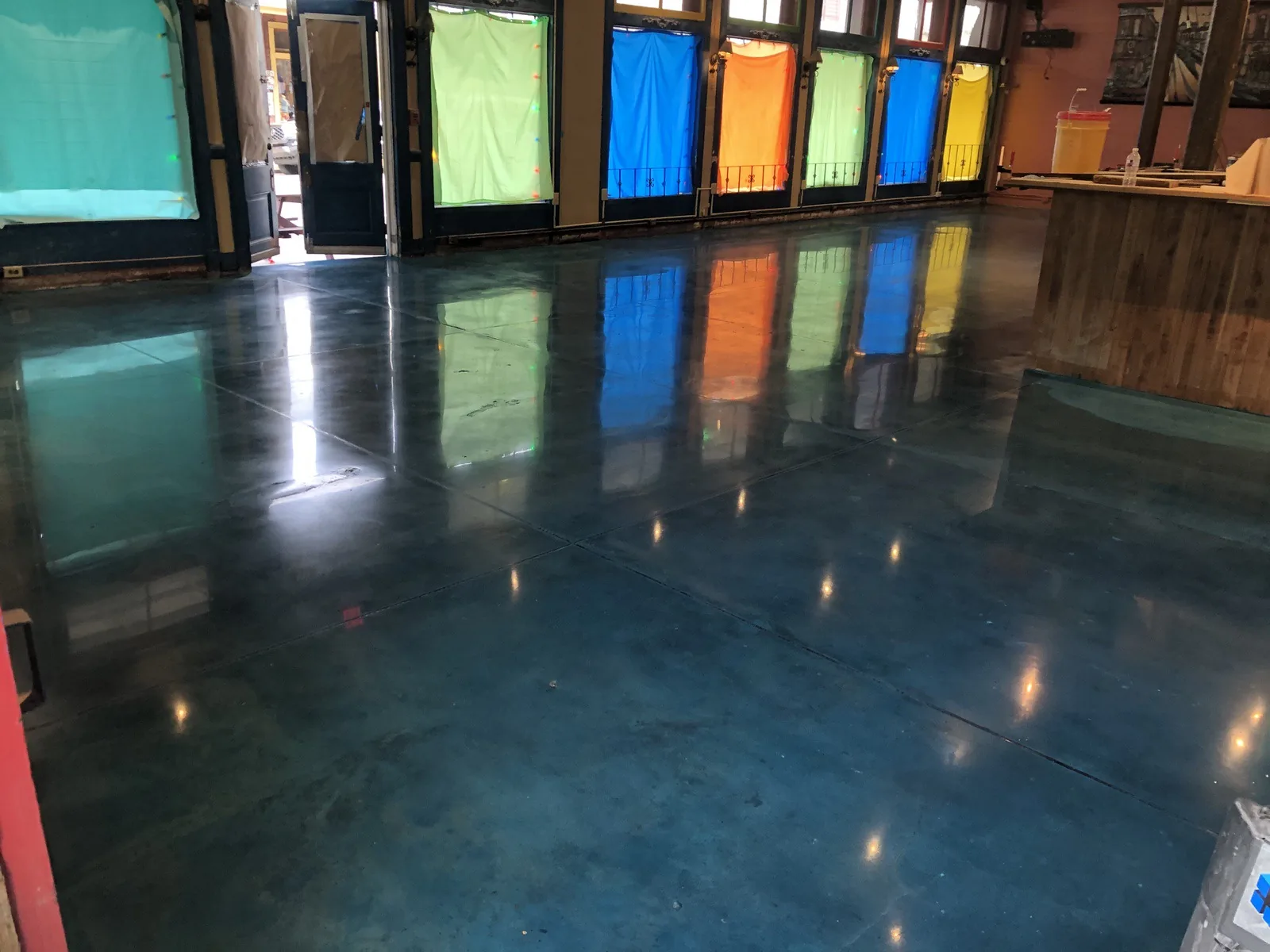
Concrete Staining
Reactive acid stain that gives a slab mottled, variegated color, scored or stenciled if you want a pattern, then sealed.
How any floor here gets built
The same order on every job, whatever the system.
The finish you actually walk on, matched to the use.
Where the system gets its build: resin, cement or a decorative overlay.
Soaks in and locks the system to the concrete.
Ground or shot blasted until the surface opens up and a coating can bite.
Whatever the slab is, it gets read first: moisture, cracks, old coatings, and how level it sits.
The next towns over
- Oak Hills Place
1.4 miles away, East Baton Rouge Parish
- Inniswold
2.7 miles away, East Baton Rouge Parish
- Westminster
3.6 miles away, East Baton Rouge Parish
- Old Jefferson
3.8 miles away, East Baton Rouge Parish
More in East Baton Rouge Parish, on the services page and in the gallery.
Straight answers on floors
Or send the plans first.
Easier to talk it through? Call the shop.
(504) 231-6298Do you come out to Village St. George?
Yes. Village St. George is about 68 miles northwest of our base in Harvey, inside the roughly 100 miles we cover. Someone comes out, looks at the slab and gives you a price after seeing it.
What should I know about a slab from around 1985?
Clear sealers were common on garages then, and they are hard to spot. If water beads on the floor, there is a sealer, and it has to be ground off before a primer will hold.
Will your crew work inside a plant with permits and safety orientations?
Yes. Plant and government work comes with site safety rules, and we have worked under a strict safety officer on a government job. Send the scope, the chemical exposure and the shutdown dates, and we will price a system that fits them.
Is Village St. George close enough for you to take the job?
Yes. The Baton Rouge area is inside the region we cover from Harvey, and we plan the drive so the crew gets full days on the floor. A contractor can send drawings, square footage and the schedule, or Dustin can come out and look at the slab.
Can you redo a floor that went under in the 2016 flood?
Yes. We take off whatever was laid over it, grind the slab back to sound concrete and test it for moisture. Cracks, spalls and loose patches get repaired before the new system goes down.
Are the new slabs in the suburbs around Village St. George ready to coat?
Not always on the builder’s schedule. Fresh concrete gives off water for weeks, and coating it early is how floors blister. We test it, and when the date cannot move we use a primer or a urethane cement made for damp concrete.
Can you quote from photos or plans instead of a visit?
For commercial jobs, drawings, square footage and a schedule are often enough to price the work, with a look at the slab before we start. For homes, photos help, but we want to see the concrete in person before we commit to a system.
Will the whole floor be out of service at once?
Not always. Larger floors can be done in sections so part of the building stays open, with the order planned around traffic. It takes longer overall, and nobody has to shut down completely.
Do I need to remove the old flooring myself?
No. Pulling carpet, tile or glue is part of our prep, and it is priced in. Some owners pull carpet themselves to save time, which is fine as long as the tack strips and pad come up too.
After a flood, how soon can a floor be coated?
Not until the slab has dried out and been tested. Flood water leaves salts and silt in the concrete, so we grind deeper and check moisture before committing to a coating. Rushing it is how a new floor fails a year later.
Call it in or send the plans
Call with the address and what the floor has to survive. Someone will come look at the slab before anybody talks price.
Send the plans
Facility managers and GCs: send what you have, even a floor plan sketch, and the dates the space can be shut down.