
Watch a commercial kitchen floor at closing. Boiling water off the kettles, a hose down the line, degreaser, fryer oil that got away, then a cold rinse. That floor goes through more heat swings in one night than most floors see in a month. Urethane cement was made for exactly that job.
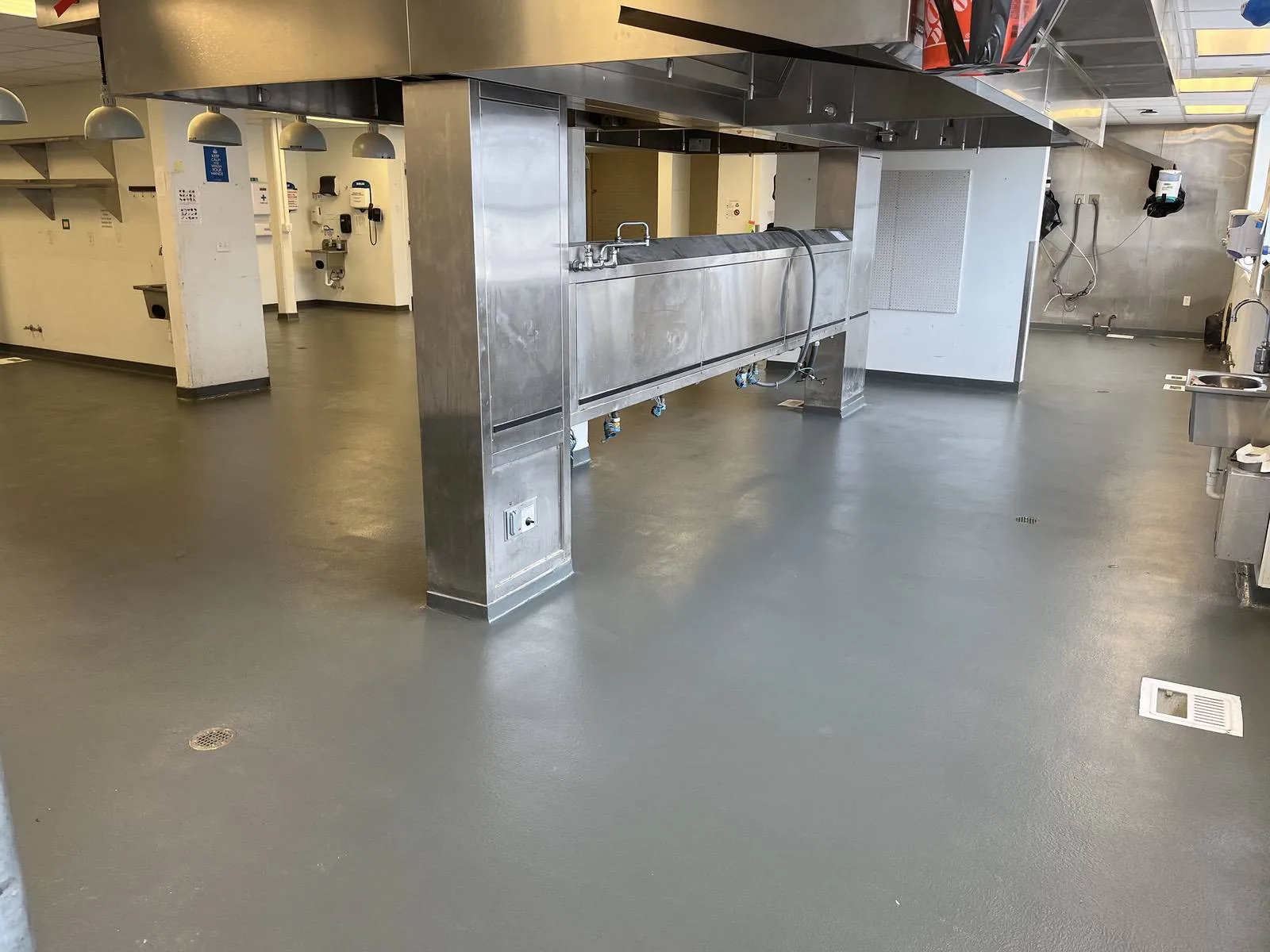
Why epoxy cracks in a kitchen
Epoxy is hard, and it is a fine floor in plenty of places. In a kitchen, thermal shock is its problem. Hot water poured on a cool floor makes the surface expand faster than the concrete underneath, and a rigid coating can crack, then start letting go at the edges. Grease and fats get into those cracks. Water follows. Before long the floor around the dish pit is a patchwork.
Urethane cement is a different material: urethane resin mixed with cement and aggregate, troweled or screeded on thick. It has some give. It handles hot water and steam cleaning, stands up to fats, oils, sugars and the acids in kitchen spills, and it tolerates a damp slab better than standard epoxy. In food service it is the system we reach for first.
Grease, cleaners and everything else
Kitchens are as hard on floors with chemicals as they are with heat. Degreasers are strong alkalis. Sanitizers, lactic acid from dairy, citrus, vinegar, blood and sugar syrups each go after a weak floor a different way. Urethane cement handles that mix far better than epoxy or sealed concrete does.
Grease is the slow one. On bare or sealed concrete it soaks in, goes rancid and smells, and no amount of mopping gets it back out. On a sealed urethane floor it sits on top until somebody cleans it up. The day the floor stops smelling like old fryer oil is usually the day the kitchen staff notices it is new.
The build, from the slab up
The slab gets ground or shot blasted to a heavy profile. Where the urethane stops, at doorways, drains and the edges of the room, we saw-cut anchor grooves so the edge of the floor is locked into the concrete and cannot lift. Cracks and spalls get repaired. Then the urethane cement goes down at the thickness the room calls for.
Thickness depends on the exposure. Typical builds for busy food service run around a quarter inch, and heavier where steam cleaning and constant hot water are part of the routine. We set it from what the kitchen actually does and how hard it gets cleaned.
- Ground or blasted slab, cracks and spalls repaired
- Anchor cuts at edges, doorways and drains
- Urethane cement body, troweled or screeded
- Aggregate broadcast for grip where people walk wet
- Urethane topcoat locking in the broadcast
- Integral cove base carried up the walls
Cove base and drains decide whether it lasts
Most kitchen floor failures start at the wall and at the drain. Water sits in the corner where floor meets wall, works under the base and rots everything behind it. An integral cove base is the same urethane material run up the wall with a rounded corner, so there is no seam and nothing for food to pack into. It mops clean, which is the whole point in a kitchen that gets inspected.
Drains are the other edge. The floor has to pitch to them, the urethane has to finish tight to the drain body, and nobody wants a ridge that holds a puddle. If the slope is wrong, we talk about fixing it before we cover it. A perfect coating on a floor that ponds water is still a floor that ponds water.
Walk-in coolers and freezers have their own rules. A cooler floor can usually take the same system. A freezer often needs a product rated for the cold, and a plan for when the box can be shut down and warmed up.
Grip with wet feet
A kitchen floor has to clean easily and grip well, and those two pull against each other. More texture means more grip and more scrubbing. We set the broadcast by area: coarser at the line and the dish pit where water and grease land, finer at prep and dry storage where carts roll. The owner and the people who mop it should both have a say.
We did a non-slip floor coating at a food plant off Gentilly Road in New Orleans, and the thinking there was the same. Put the texture where people walk wet, and keep it cleanable everywhere else.
Staying open while the floor goes in
Restaurants and school kitchens do not get to close for two weeks. We plan the work around service: sections at a time, overnight, across a weekend or during a short closure in the slow season. Urethane cement cures quickly compared with many floor systems, and fast-cure versions can take foot traffic soon after, though the product data sheet and the temperature on site set the real number.
Equipment has to move out and come back. Talk to the kitchen manager early about what rolls out, what is plumbed in and whether anything stays put for us to work around. The teaching kitchen we did for Firstline Schools at Samuel J Green School had to be finished in a short summer window before school started, and it was. Tight is fine. It just has to be planned.
What to tell us first
Square footage, a sketch or drawings showing drains and equipment, what gets cooked there, how the floor gets cleaned and with what, and when the kitchen can give up its floor. With that, Dustin can come look and tell you the build, the texture and how we would phase it.
If you are a GC building out a restaurant, put the floor on the schedule before the equipment lands, and coordinate floor sinks and trench drains with the plumber so they are set to the height of the finished floor.
Questions
How long does a urethane cement floor last?
Built at the right thickness on a well prepped slab, it lasts many years in a working kitchen. What usually cuts that short is water getting under an edge or a drain detail done poorly. Those are the details we spend the most time on.
Can it go over our old quarry tile?
Sometimes, if every tile is fully bonded and sound, but we usually prefer to remove it. Loose tile, failed grout and old mortar beds under a new floor cause problems that show up later. We check the tile and what is under it before recommending either.
What colors can a kitchen floor be?
Urethane cement comes in a range of solid colors, mostly grays, tans and reds that hide kitchen wear. It is a working floor, so pick a color that hides grease and grime between cleanings rather than one that shows every footprint.
Can you run cove base up walls with FRP panels?
Yes, we work out that transition with the GC or the owner. The cove base needs a sound wall surface to bond to at the bottom, and the panel has to finish to the top of it without leaving a seam that takes water. We look at the wall before we commit to a detail.
Someone looks at the slab, or the plans, before anybody talks price. Call the office at (504) 231-6298, email extraordinaryflooringllc@gmail.com, send the plans, or see the gallery first.