
Two floors show up on commercial finish schedules around here more than any other: polished concrete and epoxy. Both are good floors. They fail for different reasons, take different upkeep and suit different buildings. This is how we walk a GC or a facility manager through the call before anyone grinds a thing.
Start with the slab you actually have
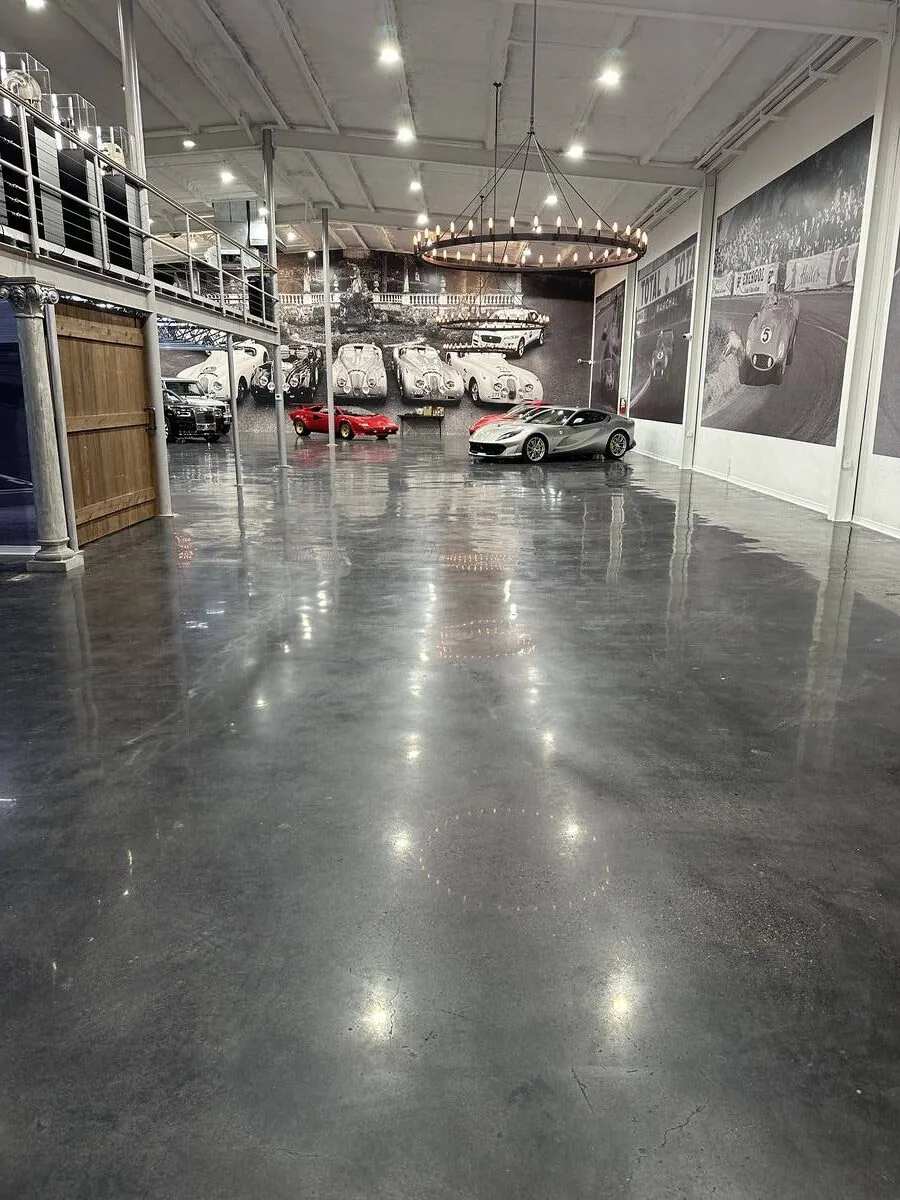
The decision usually gets made on looks, and looks should come last. Polished concrete is the slab itself, ground, densified and polished. Whatever the slab is, the floor is. A new pour with a good hard troweled finish and no curing compound trouble polishes beautifully. An old slab with patches, a mix of pours, saw cuts in odd places and stains that went deep will polish into exactly that: an honest picture of every repair it ever had.
Epoxy covers the slab. That gives you one uniform color over patchwork and lets you hide history. It also means the coating has to bond, and bonding depends on moisture, profile and contamination. A slab that would polish fine can still be a poor candidate for a coating if vapor is coming up through it.
So the first thing we want is a look at the concrete, or the age and specs of it on a new build. Dustin or Jacob comes out, walks it, and tells you what that slab will and will not do.
What the room has to survive
Traffic and spills decide more than taste does. A distribution warehouse with forklifts and pallet jacks running all shift is a natural fit for polished concrete. There is nothing on top to wear through, scuff or peel, and a hard-wheeled forklift turning in place does not bother it. Densified and polished, the surface stops dusting and takes a beating.
Chemicals change the answer. Polished concrete is still concrete. Acids, some cleaners, oil left sitting and sugary syrups will etch or stain it, guard or no guard. A plant floor that sees chemical spills, a battery charging area or a wash-down room wants a coating, and sometimes something heavier than epoxy, like urethane cement.
Schools, clinics and stores sit in between. A school corridor takes rubber soles, mop water and the odd spilled drink, and both floors handle that. The tiebreakers there are the slab, the look the owner wants and who maintains it. A custodial staff with an auto-scrubber keeps polished concrete looking good for a long time.
- Heavy rolling traffic, mostly dry: polished concrete
- Chemicals, acids, regular spills: epoxy or urethane
- Hot water, steam, grease: urethane cement
- Color coding, striping, safety zones: epoxy
- Bright, clean corridor or sales floor: either, depending on the slab
Downtime and the schedule
On a new build, polished concrete is often the friendlier option for the schedule. We can grind early, sometimes before walls go up, protect the floor, and come back for the final polish closer to turnover. The slab has to be protected from the other trades either way. Drywall mud, paint and hydraulic fluid from lifts are the usual enemies, and a stain that soaks in before we polish stays in.
Epoxy is a multi-coat system: prep, primer, body coat, topcoat, with cure time between them. It goes in late, after the dirty trades are out, and it needs the room closed and the HVAC behaving while it cures. On a renovation where a store or a plant has to stay open, we phase it in sections and work nights and weekends when the owner needs that. Short windows do not scare us. The teaching kitchen at Samuel J Green School for Firstline Schools went in during a short summer window before school started, and it was done in time.
Living with each one
Polished concrete is easy to keep: dust mop, an auto-scrubber with a neutral cleaner, and a burnish now and then where traffic is heavy. It does not get recoated. What it does need is spills wiped up and the wrong chemicals kept off it.
Epoxy is also easy to clean, and smooth enough that a mop actually works. Over years, the topcoat wears in traffic lanes, under chair legs and where pallets get dragged. A maintenance recoat of the topcoat brings it back without tearing out the system, as long as nobody let it wear down to the body coat first. In a busy facility, plan on that recoat. It is part of owning a coated floor.
Repairs differ too. A gouge in polished concrete gets patched and repolished, and the patch can show. A gouge in epoxy gets ground out and recoated, and a good color match hides it.
What each one looks like
Polished concrete looks like concrete, which is the point. Expect natural variation: some aggregate showing if we grind deep, lighter and darker areas from how the slab was finished, and the occasional crack that stays visible. Dyes can add color, and a guard gives it more depth and shine. Owners who want one even sheet of color are usually happier with a coating.
Epoxy can be a solid color, a flake blend, quartz or a metallic finish, with striping and safety zones laid out in it. In a plant, color coding walkways and work cells is a real reason to coat. In retail, the slab underneath matters less because nobody ever sees it.
The moisture question
Gulf South slabs carry water. The water table sits high, older on-grade slabs often have little or no vapor barrier under them, and the air is wet most of the year. Polished concrete breathes, so vapor coming up through it does not lift anything, though it can show as dark damp spots. Epoxy is a film on top, and vapor pushing from below can blister it and break the bond.
That does not rule out a coating. It means testing first, and if the readings are high, using a moisture mitigating primer rated for it, which adds a step and some time. We would rather tell you that on the walk-through than at a callback.
How we would call it
If the slab is sound, the traffic is heavy and mostly dry, and the owner wants low upkeep, polish it. If the room sees chemicals, needs color coding, has to cover a rough slab or sits in food service with wash-down, coat it, and pick the coating for the exposure. Plenty of jobs end up with both: polished concrete in the warehouse and showroom, epoxy or urethane in the break room, the lab and the battery charging area. For one general contractor we put down a urethane floor at a kitchen and bar plus polished concrete.
Send the drawings and the finish schedule, or have us out to look at the slab, and we will tell you which floor we would put down and why.
Questions
Is polished concrete cheaper than epoxy?
It depends on the slab. A sound new slab polishes with less work than a coating takes, while an old, patched slab may need so much repair that a coating comes out ahead. We price each one from what we see on the walk-through or in the plans.
Can you polish a slab that already has a coating on it?
Yes, once the coating comes off. We grind or shot blast it off, then see what the concrete under it looks like, because old adhesive and coating can leave shadows that stay visible in a polished finish. Sometimes the honest answer is to recoat instead.
Is polished concrete slippery?
A polished floor is generally not slick when it is dry and clean. Wet, oily or dusty, any smooth floor gets slick, so kitchens and wash areas usually get a coating with a broadcast texture instead. We can also stop at a lower polish level where traction matters more than shine.
Which one handles forklifts better?
Both can take forklift traffic when they are built for it. Polished concrete has no film to wear or chip, which is why so many warehouses go that way. Epoxy works under forklifts too, at the right thickness, with a topcoat that gets recoated as the traffic lanes wear.
Someone looks at the slab, or the plans, before anybody talks price. Call the office at (504) 231-6298, email extraordinaryflooringllc@gmail.com, send the plans, or see the gallery first.